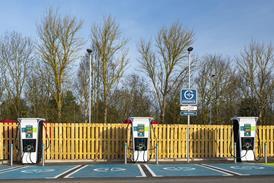


















Ultra-rapid EV charging hubs – defined as a group of six or more chargers delivering electricity at 150kW or more – are growing in number more quickly than any other type of chargepoint installation, according to an analysis of the first six months of 2025.
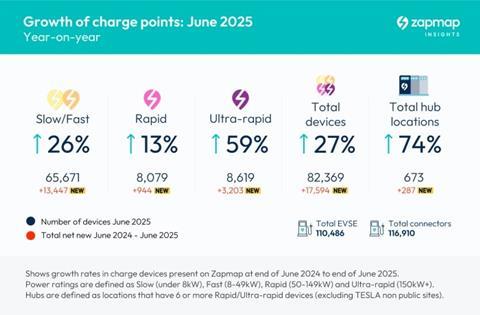
There were 537 hubs at the start of the year and 673 now, with 136 hub openings representing a 26% increase over the first six months of the year.
New-to-market locations include two opened by Osprey Charging in Merseyside comprising a combined 24 chargers. Be.EV, meanwhile, installed a group of dozen ultra-rapid points at a trade park in Greater Manchester, and also opened its ‘Charging Oasis’ in the city. The figures, from mapping and data firm Zapmap, indicate there are now 8,619 ultra-rapid points in the UK.
Slow and ‘fast’ chargers make up 80% of UK connections, however, with 65,671 of these sockets in the country. Separate year-on-year data from Zapmap indicates 13,447 of these chargers have been installed in the last 12 months, for a 26% rise.
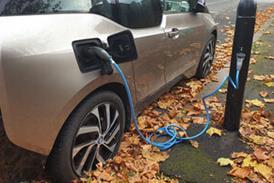
Slow chargers deliver electricity at up to 8kW and are often installed in lamp posts and used for overnight battery replenishment or when drivers have reached a destination, as opposed to facilitating en-route recharging.
‘Fast’ chargers are rated at 8-49kW, their unhelpful name a hangover from the early days of EV technology. Perceptions have changed since then, with rapid (50kW to 149kW) and ultra-rapid units becoming increasingly common, where grid capacities allow.
For reference, an electric car with a 100 kiloWatt hour battery (this is considered a large capacity) would take one hour to charge from empty to full at charger delivering 100kW, and 10 hours at a one putting electricity out at 10 kilo Watts.
Similarly, chargepoint ratings indicate the maximum speed at which electricity can be delivered, with actual rates varying based on a variety of factors. These include a vehicle’s battery condition, the ambient temperature, grid demand, and how many vehicles are plugged into one charger. For example, assuming the grid and charging unit are operating optimally, a 150kW unit with two sockets will deliver electricity at 75kW to each vehicle if both sockets are used simultaneously.
While rapid connections rose 13% from June 2024 to June ’25 for a total of 8,079 points, firms are increasingly future-proofing installations by favouring ultra-rapid, over rapid points. For the first time, there are now more of the former than the latter in the UK.
Zapmap’s head of insights, Jade Edwards, said the chargepoint landscape “looks significantly different to six months ago”, adding that the industry is looking forward to seeing “what further measures the government can introduce to make access to public charging more equitable”.