













A fuel tank repair contractor is challenging the industry standard Blue Book guide to how forecourt operators should prevent water ingress and leaks with ageing underground equipment.
IMF Solutions is calling on the Association for Petroleum & Explosives Administration (APEA), a trade body that represents regulators, manufacturers and petrol suppliers, to re-think its advice that faulty steel tanks should be fitted with a resin-based lining as a double skin system, with monitoring equipment.
Instead, IMF’s director Tim Foster suggests a full NDT (non-destructive testing) survey followed by a structural welded repair should be carried out. This, he says, is more robust, even though it takes less time and halves the cost.
The Blue Book guidance, published by APEA and the Energy Institute, is not legally binding, but an industry consensus of best practice which reputable forecourt operators will be reluctant to stray from.
Foster says that although thorough, the advice in the Blue Book in this instance is flawed. “In practice, we’re increasingly seeing it fail the sites it’s meant to protect,” he maintains.
The problem with fitting a resin lining on a damaged tank, says Foster, is that it does not restore the structural strength of steel that has already been perforated.
“Where floor or shell failure is confirmed, more resin over the failed area doesn’t repair it, it fills a void. The tank’s true condition is masked, not resolved, and the lining company’s warranty typically covers only their own workmanship, not the state of the steel underneath. The site owner keeps full liability for a structural problem they can no longer see,” he says.
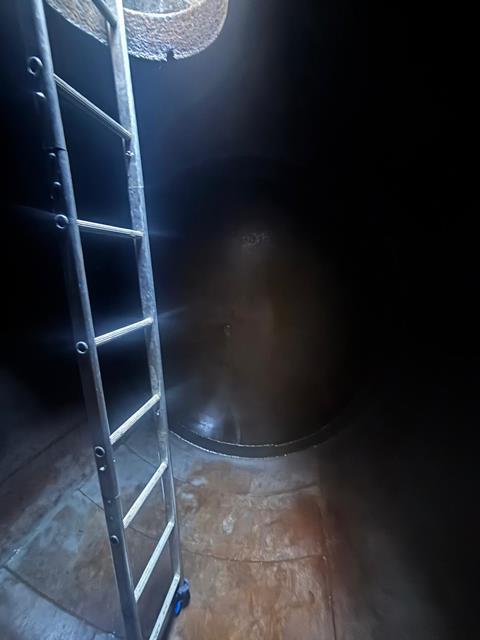
He points to a recent case in which IMF carried out a survey for a site with three tanks: two of which had been converted from three compartments to one by cutting the internal baffles. IMF found floor failure with active water ingress.
The customer had separately been quoted around £200,000 for a full resin lining, with an installation timescale of around six weeks, and, following Blue Book guidance, is likely to proceed with that option.
That, says Foster, is despite his company quoting half that price, with a promise of the work being complete in a third of the time, and the reassurance of a steel plate at least 5mm in thickness welded directly over the floor, sized and shaped to pass through the tank manway and sealed against its walls.
Such weld repairs, which can address any weak point in the shell of the tank, would be followed with a full internal layer of EonCoat, a chemically bonded corrosion protection system.
Unlike a resin lining, it bonds directly to the steel surface, rather than sitting as a separate layer which over time could trap moisture and trigger false alarms.
Foster concedes that lining steel tanks has a place as a precautionary measure to prevent leakage over time from intact tanks. However, he adds: “But where shell failure is already confirmed, the question site owners, licensing authorities and fuel brands should all be asking is simple: does this fix restore the tank, or does it just make the problem harder to see?”
Chair of the APEA technical committee Jamie Thompson says the APEA and Energy Institute welcome discussions on any new technology which helps protect the environment and supports safety standards.
He says although the Blue Book specifies that lining tanks should be double wall and checked by a notified body, there is a problem with a number of tank lining systems on the market failing to meet European standards and that many have as a result “failed in a short time”.
But he adds that since 1990, the “whole ethos of storage tank technology has changed” with 60% of existing tanks now being double wall with built in leak detection, providing security for both the operator and the regulator.