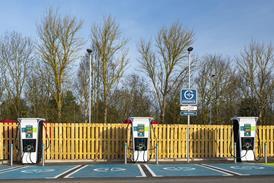













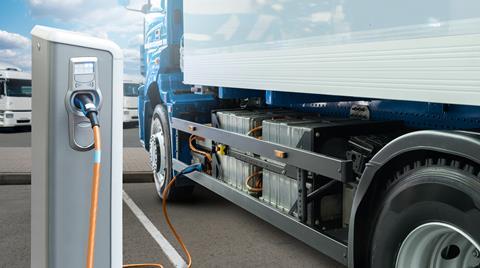
The Society of Motor Manufacturers and Traders is calling on Westminster to speed up grid connections and reduce planning red tape to facilitate the roll-out of electric commercial vehicles.
The industry body highlights that fewer than 600 of the 626,000 (0.1%) HGVs on the road today are electric, and while sales of new diesel HGVs are set to be banned entirely across 2035 and 2040, haulage operators are being told they must wait up to 15 years for the depot grid connections needed for chargers.
The SMMT highlights that the UK’s HGVs and 5.1 million vans transport 80% of all the country’s domestic freight, but as commercial vehicles cover such high mileages, they are responsible for a third of our road-transport carbon dioxide emissions, which in total comprise around 20% of the country’s CO2 output.
The organisation adds that making all UK commercial vehicles zero emission would reduce global CO2 levels by an amount greater than the Sweden’s total carbon output, though the Scandinavian country produces around 325 times less CO2 each year than China.
The SMMT says that while operators can choose from 35 different models of electric van and 30 EV trucks, just 8.3% of new van registrations are currently zero emission, against targets of 16%. Electric HGV sales remain at trace levels, with just 51 out of almost 12,000 truck purchases made in the final quarter of 2024 being zero emission.
While conceding that vans and trucks “must be commercially and operationally viable”, the trade body stresses that “decarbonising commercial vehicles (CVs) is crucial for delivering net zero”.
The SMMT’s chief executive, Mike Hawes, warns: “If operators have to wait up to 15 years just to be able to plug them into their depots, there is no case for investment”.
Hawes added that “prioritising grid connections, alongside reform to planning and action on energy costs” would speed up the adoption of electric commercial vehicles, allowing them to “continue to carry the loads that keep our economy on the move whilst doing the heavy lifting the nation needs to reach net zero”.