


















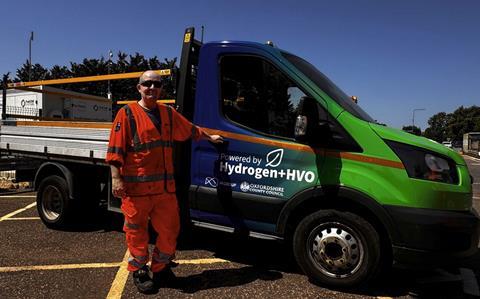
Oxfordshire has become the first local authority in England to harness hydrogen power for highway maintenance by introducing a dual-fuel hydrogen and HVO truck.
Oxfordshire County Council ‘s principal highways contractor M Group has welcomed the arrival of a 3.5-tonne highways maintenance truck – the first hydrogen-powered vehicle across the company’s 10,000-vehicle UK-wide fleet.
Compared to diesel, HVO and hydrogen fuel has significantly lower tailpipe carbon emissions by an average of 30-40%. It also reduces emissions affecting air quality, such as nitrogen oxide, which support cleaner air across Oxfordshire.
While the fuel source is new, the vehicle is not. Hydrogen technology specialists ULEMCo has retrofitted a standard maintenance truck, with the conversion funded by M Group. ULEMCo will also adapt a second vehicle, expected to be a medium or larger HGV, which will join the Oxfordshire fleet early in 2027.
Richard Lovewell, M Group’s business director, says: “M Group Highways has an ambitious target of being net zero carbon by 2040. We’re excited to be working with Oxfordshire County Council to trial practical solutions that can accelerate the journey to net zero.”
Councillor Liz Leffman, Oxfordshire County Council’s cabinet member for highways construction and repair, says: “The climate emergency is the biggest challenge the planet faces, and we are committed to not only reaching our own net zero target as a council by 2030 but to enabling Oxfordshire to be carbon neutral well ahead of 2050.
“We are delighted to be working with M Group to trial this innovative technology which will mean lower emissions and cleaner air across Oxfordshire.”
The dual fuel vehicles will be used to transport crews and materials to sites to carry out repairs and improvements on Oxfordshire’s roads.
Highways crews have received in-depth training on how to refuel, maintain and operate the converted vehicles, with a particular focus on driver and public safety.
The drivers’ experience – along with a host of metrics, such as costs and fuel usage efficiency – will help assess the overall success of the trial.