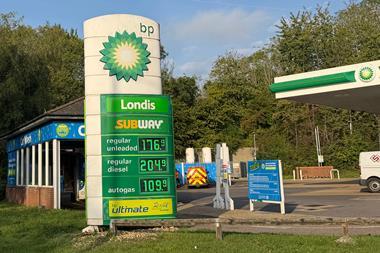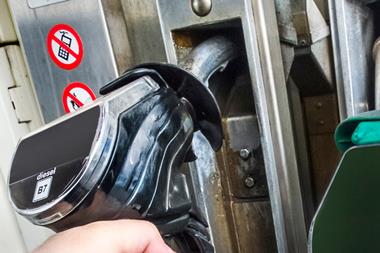













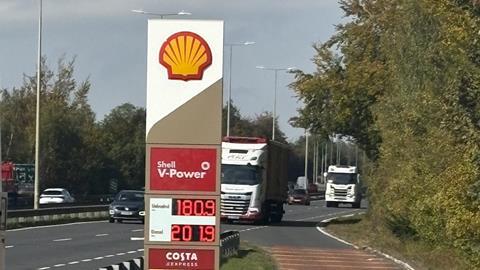
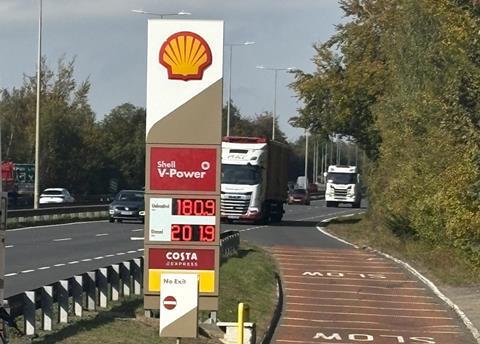
The focus on fuel at the moment – for drivers up and down the land – is definitely the price. Earlier this week the headlines screamed that diesel had reached its highest price since records began, with an average litre costing 199.18p. It’s a tad higher than in June 2022, when the price of diesel reached 199.09ppl during the Ukraine war. However, as that’s an average, it means many sites are already selling diesel for more than £2 per litre.
Karl Evans, COO at Edge Petrol, says that when pump prices cross major thresholds, consumer purchasing behaviour shifts from “fill up and go” to “currency capping” (putting in £20 or £30 at a time) and, as the price of regular diesel nears this threshold, this behaviour change is likely to accelerate.
As for the price of a litre of unleaded, according to Fuel Finder it is currently retailing at an average of 174.13p, which is still way below the 191.5p peak it reached in July 2022.
The Iran conflict back in March marked the beginning of this latest spike in prices and according to Edge Petrol, the shift in motorist behaviour was immediate and direct, rather than gradual.
In early March 2026, when the Iran conflict first hit the headlines, Evans says motorists initially rushed to forecourts. Average daily transactions jumped to 377 per day per site (versus a baseline of ~330/day pre-conflict), pushing average fill sizes up to 26.6 litres (vs a baseline of 25.6 litres pre-conflict).
He says that as replacement costs (the cost of retailers replacing their fuel) rose rapidly from 104.9ppl at the end of February to 132.5 ppl by late March, motorist behaviour shifted abruptly. Average fill sizes collapsed to 24.4 litres by the end of March.
Between April and August 2026, fill sizes dropped to 24.1 litres, reaching 23.75 litres in August 2026. Meanwhile, daily transactions climbed to ~363 visits/day in August.
“Following a brief surge of panic buying in early March, the average motorist has transitioned to smaller, more frequent fill-ups. This behavioural change continued through summer and is likely to persist for the remainder of 2026,” says Evans.
He divides motorists into two groups. The first is the ‘savvy motorist’ who looks at the news about oil prices and tops up the tank – or not – according to what is happening or is likely to happen to oil prices.
The second group he calls the ‘cost-conscious motorist’ who is on a tight budget and is really feeling the pain of the rising prices. He says they are managing household budgets by purchasing smaller quantities more frequently. They will typically put in £20 or £30-worth of fuel in each week. He says Edge Petrol stats illustrate this happening more and more.
Indeed, August volumes were down on July’s. Evans explains: “August’s volume didn’t drop because drivers stopped visiting forecourts, as footfall remained near peak summer levels. Rather, the 4.4% fall in volume between July and August was driven by budget discipline, with motorists reducing fill sizes to just 23.75 litres on average.”
Evans says that with drivers making more frequent visits (daily transaction averages are up from 327 to 363), footfall at forecourt stores is higher than last year, something retailers can take advantage of. “Retailers who capture these additional visits with strong food-to-go, coffee and quick-basket offers can offset fuel volume margin squeezes,” he explains.
Evans believes that if high diesel prices persist, there is a risk of an accelerated move away from diesel engines.
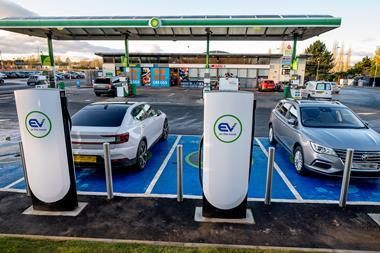
Edge Data insights for 2025/H1 2026 suggest that when diesel drivers shift, around 30% opt for EV or hybrids, whereas the remaining 70% opt for petrol engines. As a result (and because of higher MPG on unleaded vs diesel) unleaded volume demand has already risen steadily year-on-year since 2023.
Super sales
With the prices of ‘normal’ grades high, this obviously means the premium or super grades are even more expensive however, super unleaded sales are still increasing while super diesel sales are going down.
Evans says comparing grade-specific metrics reveals a distinct divergence between petrol and diesel performance buyers. Since the start of the Iran war, average daily super unleaded volume has increased by 7.22% (rising from 492.7 l/day pre-conflict to 528.2 l/day post-conflict). But over the same period, super diesel daily volume has dropped by 21.87% (falling from 378.4 l/day down to 295.7 l/day), with August sales dropping 8.76% month-on-month alone.
Pre-conflict, super diesel carried a modest +5.46 ppl cost premium over super unleaded, but by August 2026, that premium widened to +18.88 ppl.
Performance petrol drivers (and owners requiring E5) seem to have lower price sensitivity and continue buying premium petrol when it becomes more expensive. Conversely, diesel motorists, facing compounding fuel inflation, are actively trading down from super diesel to standard diesel to control costs.
Says Evans: “The dramatic drop in super diesel sales reflects a wider structural crisis in the middle-distillate market. Global refining capacity restrictions, exacerbated by regional conflict disruptions and reduced distillate export runs, drove wholesale diesel replacement costs up significantly faster than petrol. As the cost gap between super diesel and super unleaded expanded from 6ppl pre-conflict to 19ppl in August, diesel drivers voted with their wallets by stepping down to standard diesel, in contrast to performance petrol buyers who have largely absorbed the price increases.”
His advice to retailers is that given how sharply super diesel volumes drop when replacement costs spike, retailers should dynamically track their cost-to-retail gaps on super diesel rather than maintaining static margin targets that could price drivers out entirely.
Evans believes there will always be a market for premium fuels but the nature of that market is changing.
He says that with super unleaded, high inelasticity exists due to performance car enthusiasts, modern turbo engines requiring higher octane (97+ RON), and classic car owners relying on E5.
However, users of super diesel are more vulnerable to economic pressures. High-mileage fleet and private diesel drivers treat premium diesel as a discretionary add-on rather than a necessity, leading to volume contractions during price spikes.
With drivers holding on to their cars for longer, the need for the E5 grade remains with some 600,000-700,000 cars on the road that cannot use E10. These will be classic cars or some cars that were manufactured before 2011.
When E10 became the UK’s ‘standard’ grade in 2021, the Department for Transport mandated super (97+ RON) petrol to remain as an E5 ‘protection grade’ for these older and classic vehicles.
The original five-year guarantee period established during the 2021 E10 rollout is coming up for formal review. However, Evans expects the result to be a further extension to the guarantee period. “Strong demand from classic vehicle enthusiasts, older vehicle drivers, and marine/garden equipment users continues to justify E5’s footprint on multi-grade forecourts.”
The PRA says that according to the Department for Transport’s Motor Fuel (Composition and Content) and the Biofuel (Labelling)(Amendment) (No.2) Regulations 2021, a post implementation review is due in the next six months.
At the coal face
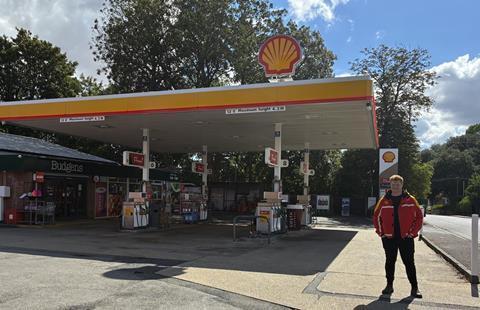
When Forecourt Trader spoke to Owain Hughes at Damory Garage in Blandford Forum, Dorset last week, he was selling standard unleaded for 183.9ppl and premium for 208.9ppl with standard diesel at 203.9ppl and premium diesel at 227.9ppl.
Hughes recently switched supplier from Esso to Shell, in part to help boost his premium fuel grade sales, and he says they are still doing good numbers on the premium grades.
“There’s no doubt that a lot of people are price conscious and volumes are suffering but we are still doing really well with our premium grades,” he explains.
At Exelby Services, MD Rob Exelby says retail fuel volumes have softened over the summer. He describes premium unleaded as being “fairly resilient” but adds: “We do notice when pump prices are relatively high, as they are at the moment, that premium fuel sales are one of the first things to take a hit, particularly if premium diesel is over £2 per litre.”
Adding AdBlue at the pump
HVO is a product Dan Perry, head of operations at Ron Perry & Son, passionately believes in. “Our sales have remained steady since our Shell rebrand, but as public awareness and understanding of what HVO actually is continue to increase, I believe it has serious potential to contribute towards net zero targets, particularly within the haulage, commercial fleet and logistics sectors.”
Perry says that in many respects, HVO’s development reminds him of the early days of AdBlue. “Initial sales of AdBlue back in the day were steady, followed by a gradual but sustained increase in demand as awareness grew and its use became more widespread. Today, AdBlue is one of our key forecourt products, with sales continuing to show healthy growth, particularly since we introduced AdBlue pumps on the car forecourt as well as the HGV bays. By introducing it early, we were well positioned to benefit as the market developed, and I believe HVO has the potential to follow a similar trajectory.”
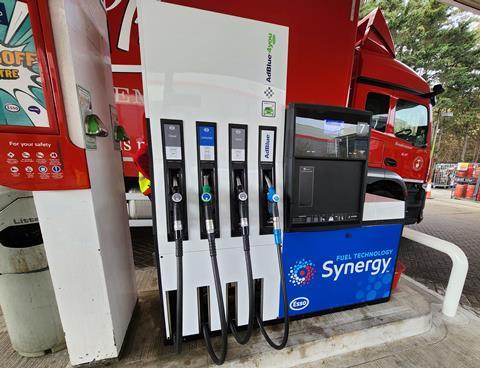
Rob Exelby has AdBlue at the pump too. He says: “Most of our pumped Adblue sales are to HGVs, but we also offer it on one car forecourt, where demand is generally good.”
Obviously there is a lot to weigh up before installing AdBlue at the pump. But Eurotank says that its customers are reporting an average return on investment for an AdBlue tank and pump installation of 12 months – and for one client it was just four months.
The company says the solution, which includes a small-footprint AdBlue tank and Mepsan AdBlue dispenser, offers the best returns on sites that have high diesel sales.
Eurotank’s group sales director, Jack Aplin, explains: “Targeting sites that already have HGV pumps will yield the quickest return as commercial vehicles will have larger AdBlue tanks and be undertaking more mileage. Additionally, our customers report only a minimal downturn in the volume of container AdBlue sales.”
Aplin says there are three possible options for making AdBlue available at the pump. “If your site is planning a full repump, it would be worth considering having one or two pumps with a nozzle for AdBlue alongside diesel, unleaded and any premium grades. This is what our customer Highway Stops did at their Park Royal Service Station in Wembley. It is a great option for sites that have a high volume of vans filling up with diesel.”
After the site redevelopment at Park Royal, Highway Stops business development director Tony Head reported: “Since installation of AdBlue on the pump, sales have been accelerating, and from a return-on-investment point of view, the speed of payback on this kit make it one of best investments you’ll make on a forecourt.
“An AdBlue pump facility is part of our standard retail offer now. For the customer it’s hassle free and easy to use – they can just pull up at the pump, fill up with diesel and fill up with AdBlue, rather than having to pick up heavy containers and walk across the forecourt. We get lots of feedback from customers about the convenience of it.”
Quick and easy
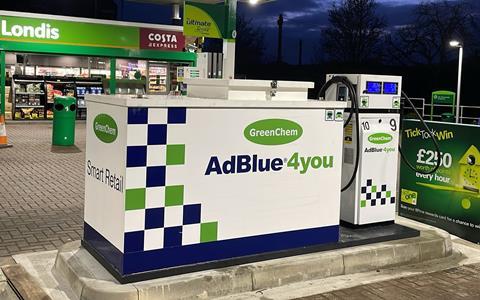
The second solution is a retail unit which includes a tank and pump that fits between pump islands and is low height so that vision is not impaired from the kiosk or the back of the pumps. The installation comes with a pump that will have a domestic car nozzle and an HGV nozzle.
The third option is a standalone tank and pump, which is normally most suitable when a site already has an HGV pump. The tank has a higher capacity than the retail unit to cope with a higher throughput of sales if there are dedicated HGV pumps on site.
“It’s a relatively quick and easy installation,” says Aplin. “If there’s not enough space for a low-height horizontal AdBlue tank with separate pump between the islands, there is a tall, vertical tank option, which also looks great.”
A kerbed island for your AdBlue tank and pump isn’t essential but it’s what Eurotank does to give the installation a more professional look.
Aplin continues: “Not all companies put in an island but we do because it looks better and gives that added protection by raising the pump and tank off the forecourt and preventing damage from car tyres.”
A quotation from Eurotank will include a Greenchem tank, Mepsan dispenser with one or two hoses, civil works including a concrete base, electrical connection, commissioning and connection to DOMS.