

















Fuel prices might not be as high as they were earlier this year but drive-offs and failure to pay remain a scourge across the petrol retailing industry.
However, there is some good news as the British Oil Security Syndicate (BOSS) has announced significant improvements in fuel debt recovery performance. The news follows the organisation’s successful accreditation by Police CPI (Crime Prevention Initiatives) which then gave it access to the DVLA’s keeper at date of event (KADOE) service.
Since receiving DVLA KADOE authorisation to request vehicle keeper details digitally in November 2025 and beginning operational use last December, BOSS has recorded a substantial uplift in its ability to tackle fuel theft incidents, including drive-offs and failure-to-pay offences.
Analysis comparing January–December 2025 data against the first six months of use (December 2025-May 2026) shows impressive progress since the introduction of KADOE access with a 32% increase in unpaid fuel reports being successfully recovered and a 48% rise in the total value of recovered fuel payments.
BOSS says these results highlight the positive impact of enhanced data access in supporting forecourt operators and strengthening enforcement capabilities across the UK.
KADOE access means BOSS can obtain accurate registered keeper details at the time of an incident, improving the identification and tracing of vehicles involved in fuel theft. This has streamlined the recovery process and increased the likelihood of successful resolution.
Claire Nichol, executive director at BOSS, says: “The results we are seeing demonstrate the real value of strong partnership working. Our collaboration with DVLA, Police CPI and forecourt operators has enabled us to make full, responsible use of KADOE data, significantly improving our ability to identify offenders and recover unpaid fuel debts. This joined-up approach is not only delivering better outcomes for the industry but also sending a clear message that fuel theft will not be tolerated.”

PROMOTIONAL CONTENT
Vars Technology: delivering up to a 90% reduction in drive-offs
Vars Technology provides comprehensive forecourt security and management services, including ANPR alerts for blacklisted vehicles and a full debt recovery service following drive-off or no means of payment incidents. A range of parking management services is also available for forecourts, with any revenue generated split with the customer. Facial recognition offers the same level of early warning and protection for retail sites that ANPR does for forecourts.
Vars Technology’s market-leading ANPR has delivered a reduction in drive-offs by up to 90% for customer sites, with forecourt staff alerted the moment a blacklisted vehicle arrives at the site. Real-time data from the DVLA also provides the make, model and colour of a given vehicle, helping staff to spot false plates.
Vars Technology holds accreditations including Secured by Design, issued on behalf of UK police forces for systems proven to reduce crime, and ISO 27001 for information security. VARS Technology is also accredited via the KADOE scheme to allow digital access to DVLA records following fuel theft. Using this system, fuel debts are returned to the operators they are owed too more quickly, with every penny recovered going straight back to the forecourt.
For more information, visit https://varstechnology.co.uk/forecourt-protection/

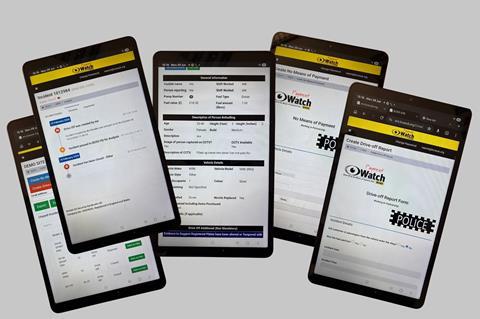
Payment Watch converted into app
BOSS’s strong results come at the same time as the organisation is launching the Payment Watch Native App, which is intended to replace the paper and manual report forms that have been in use since the Payment Watch scheme was first introduced in 2008.
BOSS says it is a major enhancement to its Payment Watch fuel debt recovery scheme, designed to help forecourt operators report incidents faster, improve data accuracy and recover lost revenue more efficiently.
The new app provides a platform for recording incidents such as no means of payment (NMoP), failure to pay and drive-offs. Developed for use across mobile phones, tablets and desktop devices, it means forecourt staff can capture and submit reports in real time, wherever they are on the forecourt.
It has been designed to improve the quality and consistency of incident reporting through structured data entry, built-in validation checks, a vehicle registration number checker and real-time capture. By guiding users through standardised fields and processes, the system aims to reduce errors and ensure that all necessary information is completed at the point of entry.
A key feature of the platform is its integration with point-of-sale systems, allowing transaction details such as fuel value, time and pump number to be automatically populated. This reduces the need for manual input, minimises discrepancies and creates a more reliable dataset for debt recovery.
During pilot trials with forecourt operators, the new app was praised for its ease of use, improved accuracy and faster responses.
BOSS says these advantages contribute directly to stronger recovery outcomes, as accurate and timely reporting is critical to successfully reclaiming unpaid fuel debts.
By improving both the speed and quality of reporting, the app is expected to accelerate case processing, helping to return money to forecourt operators more quickly.
Says Nichol: “By making it easier for staff to capture the right information first time, we are strengthening the entire recovery process. The result is not only less administrative effort for retailers, but also a quicker return of funds that would otherwise be lost.”
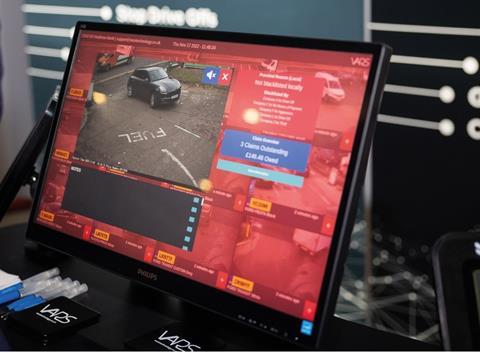
Streamlined reporting
BOSS is not the only organisation that is updating its tech to help tackle fuel theft.
Vars Technology has rolled out a new feature allowing its ANPR and debt recovery services to automatically pull evidence from a site’s CCTV system following a reported drive-off or NMoP. This means that rather than forecourt staff having to find CCTV evidence and submit it alongside a claim, they just need to provide the vehicle details, amount of fuel taken and a photo of the till receipt, and the Vars system automatically pulls the relevant footage. This cuts the time of submitting a drive-off for recovery via the Vars tablet significantly, with a new claim typically being able to be submitted in around 30 seconds.
Using ANPR entry and exit times, CCTV evidence of the driver’s entire visit to the forecourt is sent to the Vars Technology claims team automatically. This includes footage of the driver using the pump and whether they entered the shop to make or attempt payment or drove off.
When recovery is more difficult, such as with cloned plates, CCTV evidence can be provided directly to relevant police forces as evidence of criminal activity.
One forecourt operator who has been using the system says it has already delivered improvements. “Previously, during busy periods, staff have other things to focus on rather than submitting drive-offs. Some claim submissions could be missed or uploaded with the wrong evidence. Since implementing automated CCTV evidence, 100% of claims have been submitted the same day that the incident takes place, and we can be confident that our team have provided VARS Technology with everything they need to pursue the debt.”
John Garnett, a director at Vars Technology, says: “Drive-offs have been a major focus of the industry over the past few months, with the spike in prices earlier in the year driving an increase in fuel theft. That made it the ideal time to implement a new feature that simplifies reporting and evidence gathering for forecourts.
“Attempting to pursue drive-offs themselves is very labour intensive and frustrating for forecourt staff, and even when they are able to obtain driver details by applying to the DVLA, actually recovering the money can still be difficult.
“We’ve worked hard to make the process of reporting drive-offs as simple as possible using the Vars tablet, and the ability to now automatically draw CCTV evidence has streamlined that even further.
“Combined with our digital access to DVLA records via KADOE accreditation, we now have an unmatched ability to recover lost fuel money on behalf of forecourts quickly and effectively.”

The pay-at-pump solution
One way to eradicate drive-offs and NMoP is, of course, to implement a pay at pump solution. However, we all know that this is not hugely popular as it means drivers do not have to go into the shop to pay, which could cut off any chance of additional purchases.
One company offering retrofit pay at pump conversions is Nayax. Its energy sales director Andy Knight says: “We understand that many UK forecourts rely on fuel to drive shop footfall and higher-margin purchases but pay at pump doesn’t have to be an either-or decision. It gives operators another option for customers who simply want to fuel and go. Those customers aren’t necessarily going into the shop anyway – they’re looking for speed and convenience. At the same time, customers wanting a cold drink, snack or other purchases can still visit the store as normal.”
He says this is one of the reasons many operators are looking at dedicated pay-at-pump lanes at outer islands, which are often the most vulnerable to drive-offs because they offer the quickest route off the forecourt.
“By turning an outer island into a dedicated pay-at-pump lane, operators can remove that easy opportunity altogether. Drivers must pre-authorise before fuelling and anyone intent on stealing fuel is forced deeper into the forecourt, making a quick getaway far more difficult.”
Knight adds that beyond security, a dedicated pay-at-pump lane can improve throughput, reduce queues and open up the opportunity for 24-hour fuel sales without needing to keep the shop open or staff on site overnight. “In many cases, operators end up selling more fuel, not less,” he explains.
“What’s also driving interest is that operators no longer need to replace existing infrastructure to introduce pay-at-pump. Our retrofit solution is pump, forecourt controller and POS system agnostic, and can be mounted directly on the pump or on a pedestal, and it can typically be installed within a day with minimal hardware changes. It supports digital receipts, loyalty programmes and a wide range of payment methods, while allowing operators to manage one or multiple pumps from a single terminal.
“We’re seeing huge appetite for this approach. Operators are particularly attracted by the flexibility of the solution, its small terminal footprint, competitive pricing and the fact that it can be deployed without a major capital project.”