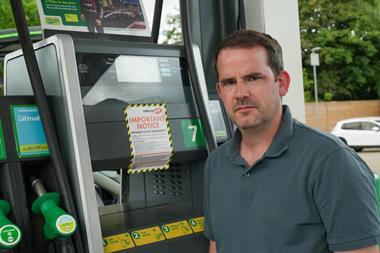













Beset by problems, Fuel Finder has become a pain in the proverbial for many forecourt operators. Epos solutions supplier CBE says that for singleton operators, keeping pricing data current may be manageable but for retailers managing dozens of forecourts, the challenge is far greater.
And that is why the company has developed an end-to-end, automated, real-time solution designed to simplify the process and improve accuracy – and it’s already being used by one of our Top 50 Indies – Ascona Group.
Clive Hughes, director UK at CBE, says: “More than 70% of our UK petrol station customer base is already using the new Fuel Finder integration. Retailers understand the importance of getting this right, but equally they don’t want or need additional pressure placed on already stretched teams. Our role is to make the process simple and seamless.”
Geoff Harding, head of fuel development and strategy at Ascona, says: “We have been very happy to comply with the new regulations, we joined the early adoption scheme and were posting prices daily. But Fuel Finder did bring another layer of complexity to our business and we knew we needed an automated system with all the bells and whistles to make it work effectively.”
Rather than having to introduce another third-party process, Harding wanted a solution that would integrate directly into existing workflows. “We looked at a few partners, but ultimately we partnered with CBE because they could take pricing directly through our existing till systems. Our thoughts were, why bring in another layer when you can automate it through an existing partner who we already have an excellent relationship with?
“If we were manually updating all 69 sites every time prices changed, that becomes a huge operational challenge. Labour is already at a premium, both from a cost and availability perspective, so automation was really important for us.”
Then, of course, there are the consequences of getting it wrong. Industry guidance suggests penalties could reach up to 5% of global turnover for serious non-compliance.
For Ascona, CBE’s solution proved particularly valuable during the rollout of the regulatory framework. “As part of the early adoption scheme, there was a lot of due diligence,” Harding says. “Like any new scheme, there have been changes and technical updates along the way. Since onboarding with CBE, they have adapted quickly to those changes without issue. They listened to our concerns, stayed transparent and supported us (24/7) as things evolved.”
Sausages herald ‘revolution’
Moving on, and when you think about retail technology, sausages aren’t usually the first thing to spring to mind. However, over at Tesco they are heralding the introduction of evolved tech.
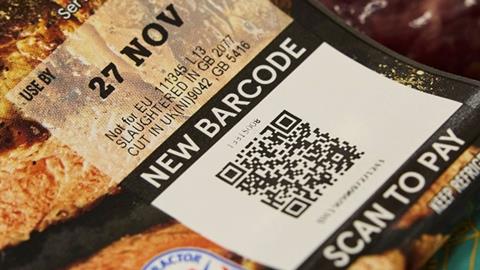
Described as “one of the most revolutionary retailing improvements in decades”, Tesco is the first supermarket in the UK to upgrade an entire product range – its own-label core sausages – from traditional linear barcodes to QR codes.
The advantages of QR codes include giving shoppers access to additional product information, such as nutritional content and traceability. They also allow retailers to have better visibility of the distribution of code lives on products in stores. This should help them to order more accurately and improve the efficiency of stock control routines, both of which will reduce unnecessary waste. And, in the event of product recalls, QR codes will allow retailers to identify the specific batches impacted rather than them having to remove all items. This will avoid throwing products away unnecessarily and will improve availability. Retailers will even be able to block the sale of affected items at the till and contact customers who may have purchased them. It sounds good and where Tesco leads other retailers follow. Forecourt Trader did ask Booker for comment on whether it might be trialling it.
The supermarket giant is also trialling a new AI assistant, built into its app, as part of its long-term plan to use AI to help make life a little easier for customers.
Launched as a beta trial with Tesco staff, the AI assistant will initially help with meal planning, providing a “natural, two-way dialogue” to offer inspiration in the form of personalised recipe ideas which will also account for different dietary preferences.
Once a staff member has found a recipe they want, the AI assistant can help them build their shopping basket within the app. Tesco is inviting around 280,000 of its staff to road test the assistant before it is launched to its customers later this year.
Apps aim to make it easy
One forecourt supplier that has recently launched an app for its retail customers is DSL.
Director Karanbir Landa says: “Time is limited for retailers, staffing can be challenging, and stores need quicker, easier ways to access products, promotions and support. Our aim was to create a platform that made it simpler for retailers to trade with DSL, whether that is placing orders, repeating previous orders, viewing promotions, managing returns, or keeping up to date with new launches.”
He says the biggest takeaway from developing the app was that technology only works if it solves a real problem. “It is easy to build something that looks impressive, but the real test is whether retailers actually use it and whether it makes their lives easier. We spent a lot of time thinking about how the app would work in the real world, in busy stores, not just in theory.”
The app represented a significant project for the business and took several months from planning, testing and training through to rollout. Indeed, DSL is still developing the platform and sees it as an ongoing investment rather than a one-off launch.
Landa says the payback is not just financial. “It is also about better communication, improved visibility, faster ordering and giving retailers a stronger experience when working with us.
“Technology is becoming increasingly important for retailers because it helps them make better decisions, save time and react faster. In convenience retail, where space is limited and every product has to earn its place, having quick access to the right information can make a real difference. The businesses that combine strong relationships with smart technology will be the ones that move forward the fastest.”
Rethinking payments
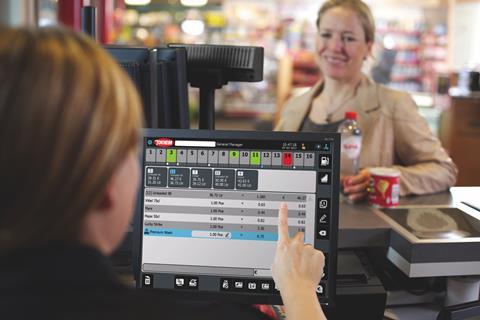
Simon Burnett, head of sales for retail and systems at TSG UK, says payment is no longer just a transaction on the forecourt; it has become a defining part of the customer experience, shaping how operators attract, serve and retain their customers.
“Payment has moved from being a simple endpoint in the journey to something that actively shapes the customer experience. Operators need to think about how every interaction feels, from the pump to the store. When payment works seamlessly, it builds trust, improves flow and ultimately drives repeat business,” he explains.
Burnett says every transaction carries an expectation of security, and the impact of a data breach can be long-lasting. “As payment volumes increase, traditional approaches to monitoring are no longer enough. Retailers are now turning to layered security, combining certified hardware, encrypted data and intelligent fraud prevention to stay ahead of emerging threats.”

Contactless cap
In March, the Financial Conduct Authority (FCA), lifted the £100 cap on contactless payments. To date, many banks have kept the £100 limit so they can monitor fraud.
Lynda Clarke, general manager UK at cashless payment firm Nayax, believes the removal of the mandatory £100 contactless limit won’t have a major direct impact on unattended fuel or EV charging in the short term.
“Pay-at-pump transactions already depend on pre-authorisation rather than standard contactless spending limits, so changing the cap doesn’t automatically change how those payments work. The bigger issue for fuel retailers is how pre-authorisations are handled, particularly where drivers only want to spend £20 or £30 but a much higher amount is temporarily reserved on their account.”
She says EV charging is slightly different: “Many charging sessions already sit below the previous contactless threshold, particularly for AC charging, while numerous sites already support contactless payment journeys. For higher-value or longer charging sessions, the industry challenge is less about the contactless limit itself and more about creating a payment flow that feels clear and proportionate for the customer.”
Clarke explains that where the FCA’s decision is important is what it says about how people now expect to pay. “Whether they are using a pump, charging an EV or buying something in-store, drivers expect the payment to work first time and without unnecessary steps. For operators, that puts more emphasis on the technology behind unattended and self-service payments, from secure processing and reliable connectivity to meeting the right compliance requirements. As forecourt payment journeys become more varied, the sites that make it easiest for drivers to pay will be better placed to retain customers.”
Is pre-payment the answer?
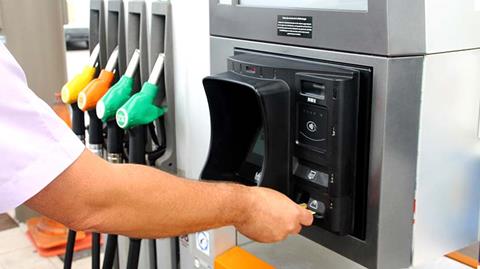
Madic UK believes pre-payment solutions could help to significantly reduce drive-off risk, while still providing a smooth experience for customers.
Its solutions include pay-at-pump app integrations with major fuel suppliers (Bpme, ShellGo+ and the Esso app); OTP (outdoor payment terminal - Madic’s MG PAY 101) and in-store pre-payment options which configure pumps to be prepay only, at set time periods, so customers have to go in-store to pay before they fill up.
Adrian Felton, managing director at Madic says: “The use of outdoor payment terminals is common across mainland Europe. With the rise in drive-offs in the UK, we are seeing more interest in them here, as they demand pre-payment.
“Retailers can configure in-store prepay rules to automatically apply during higher-risk periods, such as late evening or overnight. These controls can be applied across the entire forecourt or targeted to specific pumps that are more vulnerable. This allows retailers to balance security, operational efficiency and customer convenience.

Many people prefer cash
Cash access and ATM network provider Link says 61% of people used cash in two weeks in May, down from 69% in 2025 (June 2025 versus May 2026). Yes, the figure is down but it’s still a lot of people.
Figures from Link’s 2026 Cash Index show that while contactless cards (42%) and using your phone (30%) are UK consumers’ favourites for day-to-day payments in-store, 13% still prefer to pay in cash. This is highest for those aged 55-plus (16%) and lowest among 35-44-year olds (9%). Supermarkets were where most cash was spent, followed by convenience stores and cafes.
Late last year, Link’s research showed that while 77% of retailers still accept cash, 14% have stopped doing so in the past year. The Link Cash Index shows 45% of people find not accepting cash inconvenient and 42% of these think cash should be accepted as a matter of principle.
Only 10% of people say they are fully cashless and 56% don’t expect to go cashless in the next 12 months.
While refusing cash payments could result in lost sales, there are ongoing barriers to accepting notes and coins, including the cost of handling cash, concerns around counterfeit notes, security risks and reduced access to banking services.
Volumatic believes these challenges can be addressed with the right support and technology in place. And it certainly has the experience – working with the likes of Tesco, Co-op, Nisa and Spar to improve cash handling efficiency, reduce costs and enhance security at store level.
James Harris, managing director at Volumatic, says: “Cash handling isn’t expensive and we are here to prove that. Many of our low-cost solutions can make a real difference to small businesses, while our more advanced solutions, such as our CCi, have been proven to reduce cash handling costs by up to 75%, with a return on investment seen in a matter of months.”
Harris encourages retailers to take a balanced approach to payments, ensuring they can continue to offer choice while maintaining efficient and secure cash handling processes.
Displays that pay
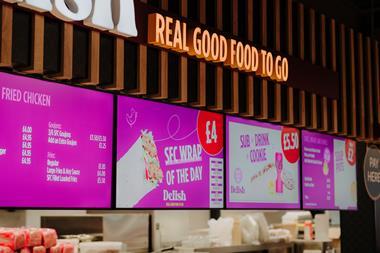
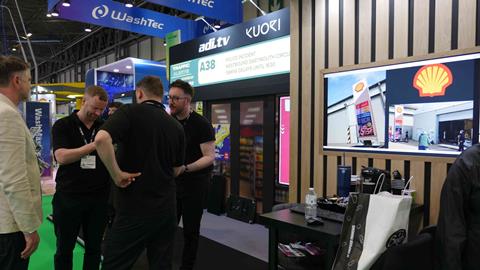
Digital displays have changed significantly in recent years, with major advances in both hardware durability and content management technology. So says Mark Burke, client engagement manager at ADI.
“We manufacture solutions designed specifically for the environments they operate in. Whether that’s roadside installations exposed to rain, sleet and temperature fluctuations, or high-traffic retail locations, our technology is engineered to perform reliably year-round.
“Our displays are also trusted by major advertising companies, global brands and sports venues where uptime and performance are business critical. That level of reliability is now expected across every sector, especially forecourts.”
Burke says what makes digital signage so powerful is its flexibility. “Operators can tailor messaging based on factors such as time of day, weather conditions, traffic patterns or promotions happening on-site.
“That creates opportunities to highlight services beyond fuel – whether that’s food-to-go, car wash facilities, EV charging, retail offers or seasonal products. Ultimately this helps drive more customers into the wider forecourt environment and grants operators a far greater return on investment.
“Our goal is to make signage more dynamic, relevant and engaging, rather than relying on static messaging that quickly becomes part of the background.”
He explains that the displays that deliver the strongest return are the ones showing the most relevant content to customers in that moment.
“If the weather is warm, promote cold drinks and ice lollies. After poor weather conditions, highlight screen wash or premium car wash packages. During rush hour, messaging could focus on grab-and-go food or useful travel updates.
“There’s also a real opportunity around EV charging which means operators can use digital signage to promote off-peak charging rates or direct drivers to available bays in real time.
“The advantage of digital signage is that content can evolve throughout the day which allows operators to react quickly and maximise the value of every screen.
“We’re also seeing growing interest in integrating live data and dynamic content, which helps make displays more engaging and useful. Ultimately, the more relevant the messaging, the greater the opportunity to influence customer decisions and drive additional spend.”
Henderson’s big screen action
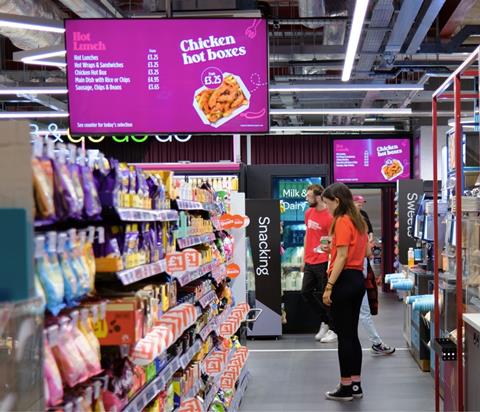
Henderson Technology has added digital media screens to its EDGEPoS platform. The new screens are designed to provide retailers with a flexible way to promote products, meal deals and in-store services. Available in a range of sizes, the high-quality LED displays enable retailers to schedule content in advance, ensuring promotions are always timely and relevant throughout the day.
By replacing static signage with digital displays, Henderson says forecourt operators can adapt messaging in real time – from breakfast offers to evening meal deals – helping to increase engagement and drive incremental sales.
The screens form part of a wider, fully integrated EDGEPoS system, allowing retailers to manage promotions, pricing and content from a single platform.
In addition, the tech firm has upgraded its electronic shelf-edge label (ESEL) templates and launched a new automated date checking feature, both aimed at reducing manual workload while enhancing the in-store customer experience.
The ESEL templates feature a new four-colour format, designed to deliver greater visibility and stronger in-store impact. The enhanced templates help retailers create more eye-catching pricing and promotional displays, while maintaining consistency across digital signage and shelf-edge communication.
The automated date checking feature automatically flags products for review based on configurable ‘offset days’, enabling staff to quickly identify which items require attention.
Henderson says early trials have delivered significant results, with stores reporting a minimum saving of one hour per day in labour, as well as reductions in waste and improvements in gross profit. The feature is available with an introductory three-month free trial, allowing retailers to evaluate the impact on their operations with no initial commitment.
Darren Nickels, retail technology operations director at Henderson Technology, says: “Forecourt retailers are under constant pressure to do more with less – whether that’s managing labour, reducing waste or driving additional spend in-store. These latest innovations are all about giving retailers practical tools that make a real difference day to day.
“Digital media screens allow stores to bring their offers to life and react quickly to trading opportunities, while our updated ESEL templates help create stronger visibility and a more consistent in-store experience across promotions and pricing. Features like automated date checking also take away manual processes and free up valuable time for staff. It’s about using technology to simplify operations, improve efficiency and ultimately create a better experience for both retailers and their customers.”