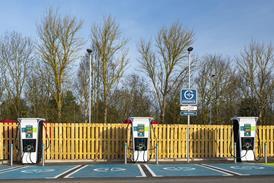
EV Off Grid (EV-OG) has revealed an ultra-rapid electric vehicle charging solution for sites unable or unwilling to get electricity capacity the conventional way to introduce charging hubs.
The new to industry hydrotreated vegetable oil (HVO)-powered device was introduced by the supplier at the ‘On The Road With Forecourt Trader, hosted by Park Garage Group’ event last week.
EV-OG’s technical and services director Gary McLean told attendees that a KFC drive-thru in Telford was the first to go live with the equipment. And to mark the two-year anniversary, it is now planning to roll out the concept to petrol retailers. Many forecourts in rural locations, for example, can find it difficult to source enough electricity to power a charging station, and this can be an effective stop gap, he says.
The “drop and go” modular system, with a built-in battery, powers two vehicles simultaneously at a 360kW capacity. Operators will need space for its 20-foot container – just under the size of a parking bay – although this bulky part of the equipment can be moved off the forecourt apron if necessary.
McLean says that the “semi-permanent” nature of the equipment will appeal to operators who want to try out EV charging before spending more on a grid connected system. “We can all get site utilisation wrong,” he says. “With this system, we can put it into your car park this afternoon. But if it doesn’t work we can remove it in an afternoon as well. So it mitigates the risk of spending a lot of time and money on a cable to the grid that may or may not work.”
Also, running off the greener alternative to diesel, the equipment provides operators with “one of the larger margins available in the EV industry”, says McLean. “We wanted to prove at the Telford site that we could hit 14p for 1kW of energy, compared with 24p for the favoured way off the grid,” he says. This gives operators scope to build in strong margins when you consider it is not uncommon for forecourts to charge around 75p p/kWh.
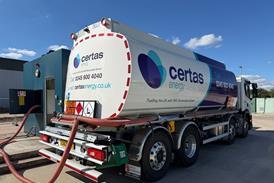
The figures achieved at the Telford site are based on HVO deliveries from Crown Oil, but operators would be free to source their own supplier giving them the chance to potentially improve margins further, says McLean.
“We are in the business of generating power for as cheap as we can, and selling it for as expensive as we can,” he told the group of 16 forecourt operator attendees to the event at Park Garage Group’s site in Rushden, Northamptonshire. This site has just been fitted with an EV charging hub using power from the grid from another supplier.
McLean says that he is talking to a couple of Top 50 Indie operators about the “semi-permanent” option, which is available on a £5,000 a month, 10-year lease, with a five-year break clause, with the forecourt operator taking all of the profit.
Going off grid, says McLean, also has the benefit of charging at the rate specified on the equipment, something which does not always happen with conventional chargers, he maintains. “Equipment linked to the grid has the potential, not a promise, of reaching the capacity it says on the charger. Quite often If you plug in a 400kW or 360kW or whatever charger, you are very likely to get a third of the capacity if you are lucky, because it is load sharing.
“Because our chargers are not on the grid they can only do what they say they will do,” he adds.
Richard Quarmby, a director of AKN Build is a significant shareholder in EV-OG, and McLean says that the duo are confident that the business has ironed out teething problems having stressed tested the technology over the past two years. “The order book is now open,” enthuses McLean.
McLean also discussed a combined battery-backed 500kWh storage system, designed to take electricity from a site’s shop to power ultra-rapid electric vehicle charging. DV8, as the charger is called, also has a guaranteed maximum speed of two charger plugs working at the same time with 360kW capacity, and like the other device is scalable, says McLean, from two to 20-plus bays.
These chargers also have 55-inch media screens for retailers to use for instore promotions, and other ideas to engage with the motorist while charging.
McLean says that with shop tariffs hitting 12p kWh overnight, the equipment offers “the highest margin from energy bought versus sold on the market”. And again the equipment is available on a lease/100% revenue model.
“We can guarantee on electricity bought at night for 12p per kW, and a charge rate of 84p per kW you are looking at making £9k a month after you have paid me for the lease for the equipment and the energy cost. That’s based on four cars charging per hour, per day, which is not outlandish to say.”