

















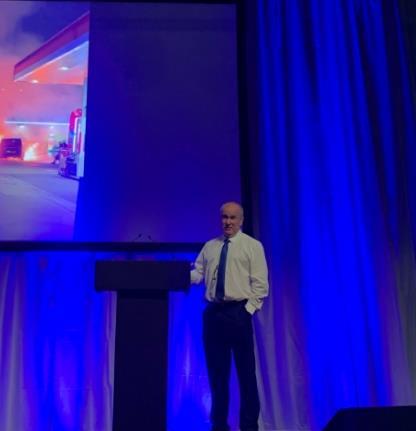
Forecourt staff should be warned against trying to put out a fire caused by an electric vehicle, warned a spokesperson from the London Fire Brigade at the APEA Live conference last week.
Showing a video of a recent fire involving an electric van on a petrol station in north London a few weeks ago, petrol inspector Rob Collins told delegates that such incidents are far more intense, giving off more smoke and noxious substances, burning hotter and longer, than those involving petrol or diesel.
He urged forecourt operators to protect staff and members of the public by labelling dry powder fire extinguishers to warn against using them to put out electric vehicle fires.
“They [petrol station employees] must have it reinforced into them the futility of taking a few powder extinguishers and having a go at knocking the fire out,” he said. “There is no way on earth that your staff are going to be able to do it.”
He also added: “You want to stop the members of public having a go with a powder extinguisher so make it quite clear to staff and to the members of public these are not to be used on electrical vehicle fires. It is just a futile experience. They are going to put themselves in danger. At best they are going to come away breathing several litres of noxious gases.”
The seriousness of an electrical fire involving a vehicle’s battery is reflected in the emergency response to such incidents, he said, with likely four or five firefighting trucks attending. This will include a command unit to organise the situation, with two senior officers – a hazardous officer and monitoring officer, and a member of the team with breathing apparatus. Police are also likely to be on the scene for roadway management.
“A car fire is a petrol or diesel fire, and you will get one fire engine turn up. This [an electric vehicle on fire] is a hazardous material and an environmental protection incident, so the attendance to it is considerably higher,” he explained.
“The amount of smoke coming off a petrol or diesel fire is not negligible but it is a lot less than an EV car fire,” he said adding that potentially thousands and thousands of litres of water will be needed to put the fire out.
“The other important thing is the length of time that incident will last, that will be hours and hours and hours by the time they [firefighters] finish babysitting those batteries,” with the possibility of a reignition, he warned.
Collins said that as soon as staff see a wisp of smoke they need to call the fire brigade immediately, and be clear that it is an electric vehicle fire.
He pointed out that with the higher intensity of an electric car fire it is important to warn occupants of neighbouring buildings of the heightened risk after installing EV chargepoints so that they can update evacuation procedures.
“Look beyond your forecourt,” said Collins. “What is outside the boundary is just as important as what is on the forecourt itself. “That fire will be burning a lot longer, giving off a lot more heat, and a lot more smoke, and more gases,” he said.
The cost to an operator of an EV charger fire is also likely to be substantially more as well because of the heat involved. “With the intensity and the length of time that it burns, that flooring is going to have to be replaced, and anything surrounding it is going to have to be replaced,” he said.
Staff need to be told about the thermal runaway and the hazards that come with that he said. “If they can smell the fire then they are breathing in noxious gases, and there is a lot of horrible stuff inside,” he warned.
The forecourt team also needs to be informed about how the run off of water used to put out the fire will be dealt with. “They [firefighters] are going to be putting thousands and thousands of litres on this fire. It is all going to be contaminated and it has to all got to be going somewhere. So they need to know about the inceptor where this water is going to go and what is the capacity of the interceptor itself,” says Collins.