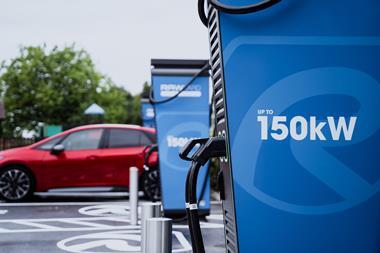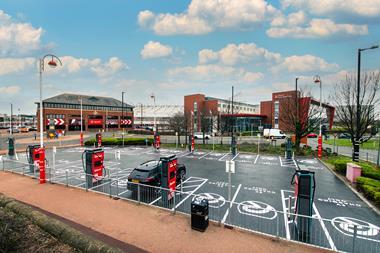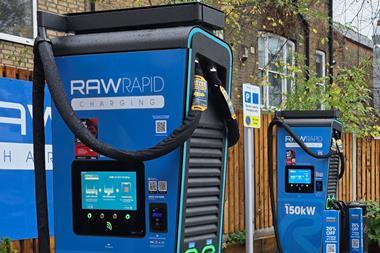




















Love them or loathe them – EVs are not going away any time soon. Many forecourts have embraced the EV charging challenge and now have chargepoints on their sites. Others are still debating about if and when to add chargepoints. The problem is, it’s not as simple as just deciding to have them and giving them a go.
As many petrol retailers know to their cost, choosing the right partner can be tricky, finding the right space for those chargers can be challenging and actually getting enough power to your site can be costly. And then there’s the fact that nobody has a crystal ball to see just how popular chargepoints might be on your site and whether they would increase footfall and shop sales.
Luckily there is tech available that can help in making a decision on EV charging. Evenlode Roadside launched its Edison profiling programme last year which went on to win the APEA Innovation Award in November 2025. Edison provides a detailed site-specific report providing a forecast of likely demand and the sort of financial returns that could be achieved.
It has already helped Top 50 Indie Park Garage Group (PGG) identify the EV charging opportunity at its Yeomans site in Maidstone, Kent.
PGG director Manoj Tandon says Edison was extremely useful in helping the company identify charging opportunities. The Yeomans site hasn’t gone live with charging yet as PGG had been focusing on its Rushden forecourt, which opened its charging facilities last October.
“We are planning to offer charging at Yeomans, Mogador(Tadworth) and Durham before July. We also have plans for a complete site redevelopment for Twenty Mile in West Kingsdown in Kent, which will include EV charging. We hope to get started on that later this year.”

Important factors
According to Evenlode director Philip Reece there is no hard-and-fast formula for whether a site would do well with EV charging or not: “There are some trends, but it really is site specific. We’ve modelled good and bad prospects in most regions of the country, both urban and rural. The Edison modelling takes into account factors including local BEV numbers, home-charge capability, the relevance of local competitors, driver habits and vehicle charge capacities.
“In some ways, there is a formula, because the model uses carefully developed metrics to provide its forecasts in a methodical and systematic way, drawing on multiple sources of licensed data.
“Grid availability (and cost) is an important factor, but only if there is sufficient customer demand in the first place. Just because there is grid availability at a location, does not mean customers want to go there to charge either.”
Retail forecourt consultant Ramsay Macdonald says the most important question in deciding whether to install anything on a forecourt is always: “Will it payback and make a return?”
“The Edison modelling is helping operators to understand both the overall local demand and give a projection of how much of this demand would convert into customers at that specific site. The first consideration is therefore – is there enough demand to justify investment?
“The modelling considers the competition in the local area, and the relative merits of the operators site – if the site is not attractive to EV drivers when compared to the competition, then why would they go there?”
Macdonald adds that once likely demand and revenue are known, then a budget can be set for installation. “This provides key information for obtaining costing for both the chargers, supporting customer pleasing hardware, integration with payments and marketing, and perhaps the biggest cost for many sites, the size of electrical connection needed, and the timing of this.”
Reece says they know of sites which have had connection quotes for very large sums but when modelled, there is not the demand there for that amount of charging. “Early information can be vital to inform accurate site feasibility,” he explains.
And, of course, there are examples where Edison says the site is just not right for chargepoints.
Evenlode sales and solutions director Paul Muncey says they have recently modelled sites where the results were either showing borderline cases, or there was very low actual residual demand once the competition was factored in.
“The Edison report can help operators to avoid costly mistakes, whether through their own investment, or tying up valuable space coveted by third-party chargepoint operators (CPOs). As an example we recently modelled a site which a number of prominent CPOs had made proposals for but, given the low local demand overall and prominence of other strong EV charging competition, was not favourable.”
Full upgrade
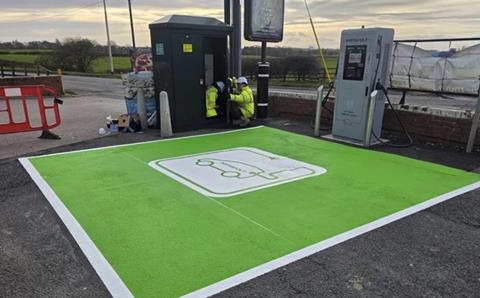
CPO Instavolt was the initial partner when Top 50 Indie Penny Petroleum began its EV journey almost a decade ago. Penny chief commercial officer Tony Jackson says: “Instavolt has recently completed a full upgrade across our portfolio, at their cost.”
As part of the upgrade programme, older charging units have been replaced with faster ultra-rapid chargers capable of delivering up to 120kW.
Jackson believes the profile of EV charging has developed rapidly within the marketplace which has influenced Penny’s plans. “The realisation that EV users tend to favour multi-bay, multi-convenience locations, means that single bay EV charging at fuel forecourts tends to be a distress purchase. We have undertaken significant analysis of the EV market and while we will continue to monitor trends and development costs closely, any further expansion on our existing portfolio is not currently a priority.”
Meeting local needs
EV charging is like most things that can be offered on a petrol station site – if it is done well and meets the local need, then a good return can be met.
“Plenty of CPOs are finding out that simply deploying chargers out all over the country is not the way to drive a return on investment,” says Reece, who adds that there needs to be a sense check when it comes to income expectations.
“Whereas a petrol pump can serve multiple customers one after another, the ‘dwell time’ of an EV charging session is typically a lot longer, so there is less scope for the volumes of vehicles that an operator can normally expect to serve. Just because you see the numbers of BEV vehicles on the road slowly growing, does not mean they all need to charge on a forecourt as they can be charged in multiple locations such as at home and at work.
“As part of the modelling we do, we can help operators to understand the possible margins available on both the KWh sales and also complementary sales such as in the store, working closely with them to consider the range of revenue likelihood. We don’t stand to gain whether you install chargers or not. We want to help people make informed decisions that work for them.”