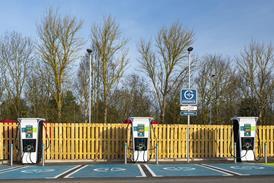




















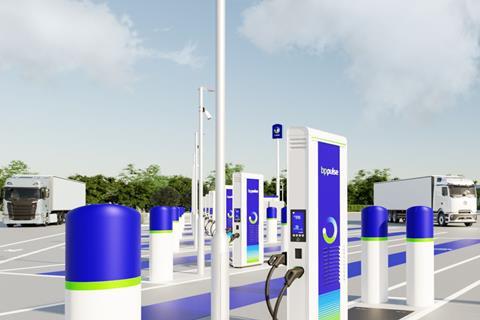
Moto is installing six megawatt (1,000kW) BP Pulse charging bays for electric trucks at three of its motorway service areas.
The move comes ahead of the phasing out of sales of new diesel HGVs. As things stand, new derv trucks weighing 26-tonnes and under will be banned from sale in 2035, with all new lorries having to be zero-emission from 2040.
The bays will be installed at Moto’s Lymm services on the M6, and Toddington North, and Toddington South services on the M1, with the first set to go live in 2026. Moto plans to offer “up to 300” HGV charging bays at 23 locations by the end of the decade, and says this is a “natural extension” of its work around EVs, which has already seen the firm invest “heavily” in recharging.
The HGV bays will be of a ‘pull-through’ design to allow for easy manoeuvring, while the charging units will all be megawatt charging systems (MCS), which brings with it its own unique plug design – though CCS connectors will also be on offer.
The new units form part of BP’s plans to roll out a network of megawatt charging stations for trucks in conjunction with the Trans-European Transport Network (TEN-T) project. This is an EU scheme backed by legislation that the European Commission describes as “a coherent, efficient, multimodal, and high-quality transport infrastructure”. TEN-T also aims to “reduce the environmental and climate impact of transport”.
Six BP Pulse HGV recharging sites have already gone live across the Rhine-Alpine Corridor, which connects Rotterdam in the Netherlands with Genoa in Italy.
With electric trucks’ batteries typically having a capacity of around 500 kiloWatt hours (kWH), a megawatt charger can theoretically recharge an eHGV from full to empty in 30 minutes, assuming a continual delivery of electricity at 1,000kW. These speeds can facilitate a more typical 20-80% charge of the same size battery in 18 minutes. The Mercedes eActros 600, one of the latest-generation of electric HGVs, has a 621kWh battery that provides an official laden range of 311 miles.
Commenting on the planned HGV chargers, Moto’s chief executive, Ken McMeikan, says his firm is “committed to leading the way in enabling the UK’s electric mobility”, and the partnership with BP Pulse is “making our vision for long-haul electrification more practical and accessible”.
Jo Hayward, BP’s vice president for mobility & convenience retail describes the partnership with Moto as “a perfect fit”, and that the two companies are “making it easier for fleet managers to keep their electric trucks moving with less downtime, lower emissions and a clear path to an electric future”.
BP Pulse’s vice president for European E-trucks, Nigel Head, says his firm’s work in Germany, where it is the largest operator of public HGV chargers, has shown: “this model works, and now we’re applying that same expertise to the UK”. He adds that Moto’s service areas “offer an ideal foundation” due to their “strong motorway access”.
This isn’t BP’s first foray into HGV recharging in the UK: last year the oil major acquired the freehold to a vast truck stop in Ashford near Dover, and plans to install 20 HGV charging bays there to serve some of the 3.5m HGVs that use the port each year.