










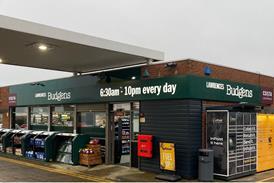

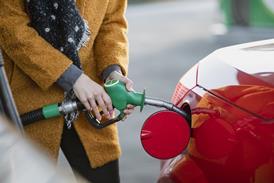






When rumours began circulating that he had passed away, Mark Twain politely dismissed such talk as being “greatly exaggerated”. Over 100 years later, the same comment could be made about an EV chargepoint firm’s recent pronouncement on the petrol station.
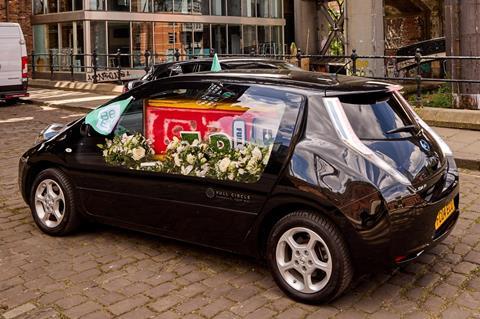
The firm in question is Be.EV, whose chief executive, Asif Ghafoor, recently said “we need to call the undertaker in for petrol and diesel stations” and repurpose the “soon-to-be-useless land” that forecourts occupy. The company even went so far as to commission a photoshoot that produced images of a petrol pump on a gravestone and in a hearse. If you work in or write about the petrol-station industry, that’s very much a case of shots being fired, so it seems only fair to offer a return volley.
First, this is an inappropriate way to talk about and depict the potential death of an industry that employs tens of thousands of people, serves countless communities, and in many cases comprises family firms handed down through generations – not to mention the £25 billion of Fuel Duty the sector collected for the Treasury in the last financial year alone.
Second, statements such as this make it reasonable to scrutinise the EV sector, which is hardly in rude health itself.
Electric cars, after all, only really find take-up when they’re subject to vast tax bungs, as seen in the salary sacrifice schemes that prop the UK’s EV sector. Those schemes allow people to pay for a shiny new battery car out of their gross, rather than net pay, meaning these vehicles are heavily subsidised by the government and, by extension, taxpayers.
This is hardly the sign of a robust industry or popular product, not least when the sector Be.EV belittles is a net contributor to Westminster’s coffers, and on a massive scale. With forecourt tax receipts so high, and £2.3bn of taxpayer money earmarked to encourage EV uptake, the Fuel Duty from every tenth litre of unleaded and diesel sold in the UK is effectively used to discount and facilitate electric cars.
The important matter of jobs is also worth close scrutiny. UK petrol stations employ around 43,000 people according to Ibis World, and it’s fair to say the chargepoint industry employs fewer. What jobs do exist in the socket sector will likely be office-based roles or ones that require technical engineering qualifications. With the vast majority of EV charging hubs unmanned, there will certainly be far fewer positions that are open to people who may not have an established CV or a raft of qualifications. By contrast, the forecourt industry is known both for offering countless entry-level roles, and for rewarding dedicated and competent staff with ground-up career progression.
All this is before we start to consider the wider implications of the switch to electric cars, which is a top-down, legislative imposition from government that is hugely unpopular with the majority of consumers, who choose anything other than an EV in nine out of 10 of new-car purchases.
Let’s also gloss over the fact that the European automotive sector is in dire straits due to the growing prominence of electric cars from China – a country that processes and refines around 90% of the materials that are essential from EV batteries. Our policies have literally handed another country control over the means of production – a core concept of political philosophy that appears to have been overlooked by senior figures.
And while the forecourt sector not only washes its own face – managing to turn a profit while handing over huge sums to government – it’s not just electric cars themselves that need a helping hand: chargepoint operators are also receiving rounds and rounds of cash injections.
One company, Believ, was recently handed a £300m investment. Sums such as this may indicate investors are confident that chargepoint firms are a wise bet for the future, but that’s a very different proposition from the one painted by the forecourt sector, which is profitable for firms and government today.
There also seems to be some weakness in Be.EV’s calculations. The company appears to have plotted a straight-line graph predicting that given 40,000 forecourts existed in 1967 and 8,353 in 2023, there may not be a single petrol station in the UK by 2038.
This fails to take into account the fact that the number of petrol stations has declined over time for a variety of reasons, including changing retail models and consumer behaviours, the evolution of the UK’s road network from the 1960s to now, and tightened regulations surrounding petroleum licensing; most would agree, after all, that it’s a good thing petrol is no longer sold from village shops and chemists, as it once was.
We also need to bear in mind what people actually drive, and what they will drive in the future. Today, 96% of cars need petrol or diesel, and to think that figure will have fallen to so low a point by 2038 (just three years after the ban on the sale of new cars with internal combustion engines has come into force) that it won’t be worth the market catering for drivers who need traditional fuel is an interesting conclusion, to say the least – especially when people are holding onto their petrol, diesel and hybrid cars for longer as they eschew EVs.
So while I wish Mr Ghafoor and his firm well, I would politely suggest he and his team revisit both their statement and their maths. As far as I’m concerned, neither bears much scrutiny.
- This article was updated on June 25 to remove reference to Be.Ev receiving a £20m investment from Schroders Capital, as Be.Ev invested £20m to install chargers at Schroders sites.