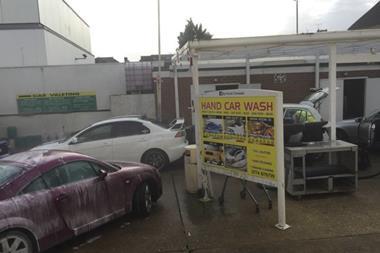
















As millions of people are hit with hosepipe bans in the UK, the Car Wash Association (CWA) has been making progress in persuading water suppliers to allow responsible valeting hubs to remain open for as long as possible during shortages.
With concerns of possible impending droughts and the prospect of further usage restrictions this summer, it has been intensifying the case that car wash operators adapting their businesses to minimise water consumption should be given preferential treatment.
And it says that South East Water, one of the UK’s water suppliers to be hardest hit from the latest series of back-to-back heatwaves, has confirmed that it would “take account of and make allowances for such business users”.
The CWA’s director of strategy Alexander Russell, adds: “They [South East Water] have recently confirmed that this has now been adopted as good practice by the water supply industry as a whole.
“They have also confirmed that there would be no restrictions on private tankering of water by car wash operators from neighbouring districts with sufficient reserves.
“However no new boreholes would be authorised as aquifers are already at capacity, and the hosepipe ban would remain in force.”
In recent years car wash operators have been implementing a series of voluntary measures to reduce dependence on the grid, such as installing recycling equipment that reuses up to 85% of the wash water; investing in boreholes and even using waterless washing.
Simply by fixing leaks, says the CWA, operators can save 20-25% of their water consumption. Also, minimising pre-washing, and reducing the pressure of jet washes, can help to save between 40-70 litres per wash, it advises.
“A lot of sites with conveyor machines use prewash as part of the theatre with operatives spraying snowfoam over the entire car, but by focusing on the hard to reach bits under the front and back bumper, for example, water use can be reduced by 75%,” says Russell.
Thames Water and South East Water are among those to have already announced hosepipe bans. And with months of record dry weather the country is facing the prospect of further restrictions being imposed by water companies on high-volume users of water, warns the CWA.
During previous droughts in the UK in 1980s and 1990s, less scrupulous operators were forced to close, says the CWA.
The trade association says that it has since early August 2022 been lobbying for responsible car washes to be given preferential status, so that sites in the future would be motivated to invest in water-saving initiatives, and motorists would not be tempted to use hosepipes to covertly wash their vehicles at home.
“We are badgering all the water companies that these businesses rely on water and that responsible ones, who can usually be identified by having applied for a trade effluent licence and don’t just accept cash, should be treated differently to others,” says Russell.
“We have also stressed with the water companies that unless such careful companies are treated more leniently than non-recycling operations in the event of a progressive ban, this would deter such businesses from investing in this equipment in the future.
“Furthermore, these restriction measures should be implemented on a regional basis according to need as previous experience has shown that not all regions of the UK have been similarly affected by water shortages.”
In previous droughts, the CWA has also sought agreement with water authorities on the display of approved signage that identifies that operators are acting within the rules.
“This is intended to avoid any unfair misunderstandings by members of the public wrongly assuming that operators may be flouting a ban,” says Russell.
The CWA warns that car wash operators should be mindful of the fragility of the UK’s water supplies in the future.
”With no new major reservoir being built in more than 30 years, a growing population, and higher risks of hot, dry summers, restrictions on car wash operators who do not take action to reduce their water consumption will occur in coming years, and imprudent operators will inevitably lose out,” says Russell.
He adds: “The CWA has been acting on this information and taking steps to enable car wash owners to continue operations for as long as possible.”