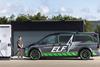
Mercedes Elf

Source: Mercedes-Benz

Mercedes-Benz is testing the new ELF experimental charging vehicle, which it says could lead to extremely fast charging processes that are similar to the time it takes to fill a vehicle with traditional fuel.

The name ELF is derived from the German term experimental-lade-fahrzeug – which translates to experimental charging vehicle. The findings from the prototype charging station are being directly incorporated into the development of a new generation of high-performance fast chargers, which are to be used at Mercedes‑Benz charging parks.

The car giant says the ELF mobile charging lab unites ultra-fast, bidirectional, solar, inductive and conductive charging in a holistic concept which tests the limits of what is technically feasible – both in the vehicle and at the charging station. To this end, the experimental vehicle is equipped with two fast-charging systems that cover different areas of application.

The MCS connector (megawatt charging system) was originally developed for heavy-duty transport and allows charging capacities in the megawatt range. In the ELF, MCS serves as a research tool for testing the thermal resilience and performance limits of high-voltage batteries, power electronics, charging cables and other components under extreme conditions. The findings are being incorporated into the development of long-distance vehicles and fleet solutions with short downtimes.

The second system is the CCS connector (combined charging system), which is used as the standard for passenger cars to test near-series components such as cables, connectors, cooling and charge control under everyday conditions. Mercedes-Benz is testing the technical limits of CCS to create the conditions for even higher charging capacities. The ELF can achieve a charging capacity of up to 900kW. This means that 100kWh can be charged in 10 minutes. The vehicle simulates typical charging scenarios that occur in everyday customer use, such as at fast-charging stations along motorways or in urban areas. The components used, such as the battery, charging control and CCS hardware, are already close to series production and will be incorporated into future Mercedes‑Benz models.

One example of how the knowledge gained is being directly incorporated into the development of future series models is the Concept AMG GT XX technology programme. The concept vehicle can recharge enough energy for a range of around 400km (WLTP) within five minutes. The vehicle achieves a very high average charging power of 850kW at 1,000 amps over a large range of the charging curve.

With the ELF, Mercedes‑Benz is also exploring the full potential of bi-directional charging, with the vehicle testing bi-directional charging in real-world scenarios. The findings will be fed directly into the series development of future models.

Mercedes‑Benz has so far successfully introduced bi-directional charging in Japan and next year will launch its first services for bi-directional charging in Germany, France and the UK. The MB.CHARGE Home offer combines the vehicle, bi-directional wall box, green electricity tariff and energy market access. The aim is to reduce household costs and support grid stability.

With the ELF, Mercedes‑Benz is also testing charging without cables using induction. This involves transferring electrical energy to the vehicle without a physical connection via a charging system integrated into the ground. The company says this technology offers great potential, especially at home and for fleet applications, as it makes charging more convenient and virtually invisible.

Yet another innovation Mercedes-Benz is testing is robot-assisted charging which allows vehicles to be connected to the charging infrastructure precisely, safely and without any manual intervention.