














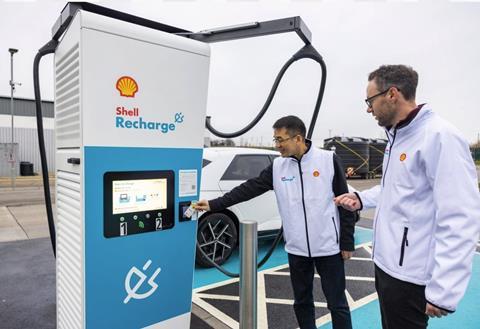
Shell is rolling out its Recharge electric vehicle charging package after a proof of concept project, in which dealers pay for the installation of the equipment, has proved successful with service area operator Exelby Services.
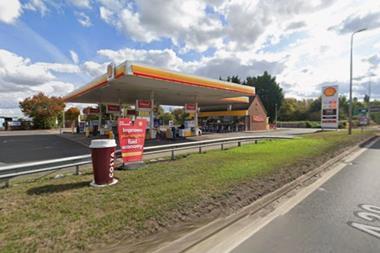
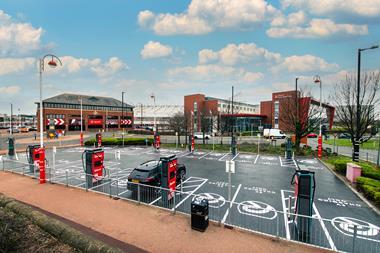
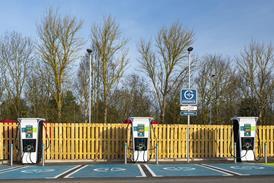
The five-site family business started operating four bays of chargepoints at Coneygarth services on the A1(M) in May last year. Managing director Rob Exelby says that in six months the hub had a consumption of 20,000kW per month – the level that he had predicted to reach after two years..
Now with the site hitting around 22,000kW a month, Exelby expects payback on his investment on adopting Shell Recharge will be in six or seven years, four or five years earlier than he had originally hoped for. And he says the chargers’ reliability uptime has been maintained at more than 99%.
“So far it has far far surpassed our expectations,” says Exelby. “We had done some projected figures on what we had hoped to do after one year and two years, and after six months we were already hitting the consumption that we expected after two years, so we are really encouraged,” he adds.
Shell Recharge originally launched in the oil giant’s company-owned network in 2017. The brand is now available at 250 of 560 of its own sites, which have 1,100 high speed charge posts between them.
Now the business is making the brand available to dealers on a margin-share model in which operators pay for the equipment, and with it offering a selection of hardware at preferential rates. Once installed the equipment is maintained by Shell.
Dealers also benefit from Shell giving support with its loyalty app, which includes EV charging purchases and now has a subscription offer giving EV customers discounts on charging for a monthly fee. Also dealers with Shell Recharge benefit from Shell’s marketing, and its back office system taking care of customer billing, card handling, and roaming agreements, says its sales and operations manager, Shell Mobility UK Steve Bean.
“Dealers are not isolated with standalone equipment,” says Bean. “It’s not just about helping put the chargepoints in the ground it is about how we can help bring the customer to them faster than if they did it on their own.”
As well as Exelby Services, The Kay Group has also installed Shell Recharge at one site, and Bean says that a third dealer is about to come on board. “We’ve got interest from another 12 dealers already and would expect to have 15 dealer sites by the end of the year,” he says.
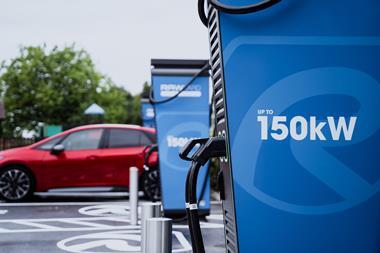
Exelby has so far invested £525k at his Coneygarth site near Northallerton in North Yorkshire: Installation cost £275k which included the cost of the 200kW chargers; the switch gear equipment; and civil works for the cabling and foundations.
The four connectors’ energy output is capped at 300kW, and Coneygarth had that amount of spare electricity. But Exelby is now awaiting more power to allow for another 14 chargepoints, and to upgrade his existing Alpitronic equipment to 400kW: another £250k of expenditure.
Exelby liked the autonomy of the Shell Recharge model, which gives him freedom to manage his own electricity retail prices. “I wanted to be able to do our own operation and utilise the power of the Shell brand and the relationship we have with Shell. The customer still feels like they are getting that Shell experience but it’s from us as a family company.
“We have faith in electric charging and the hardware so I was happy to put my hand in my pocket and pay for the installation ourselves, we then take a more advantageous cut of the margin and Shell get their percentage commission for operating the payment platform and the loyalty platform, so it is a good partnership between the two.
“I think the margin I get is very reasonable – if I were to put a figure on what the Shell Recharge brand is worth to us as an operator and to the customer I thought it was a fair commission,” he adds.
With Coneygarth being a transient site, Exelby says he is getting a “healthy mix” of passenger cars on long journeys and light vans, mainly from utility companies like British Gas, and parcel delivery businesses like Royal Mail and DHL, using the chargers. Utilisation is spread evenly throughout the week, and most of his EV customers spend 30 minutes charging their vehicle.
An Air-Serv screenwash, air, vacuum and fragrance unit, positioned between two of the bays has also been performing well, and anecdotally Exelby has noticed users of the chargers are buying snacks for their journey while charging. “We are seeing supplementary revenue streams on top of the charging,” he says.
After an initial offer price, Exelby has now settled at charging customers 79pkW: with prices displayed alongside petrol and diesel retails on a totem. “This is still competitive based on our location and the power of the chargers,” says Exelby. ”It gives us a good margin and return on investment, but customers still see it as a competitive rate compared to the like of Gridserve and other providers,” he says.
With Exelby’s petrol and diesel sales increasing year on year – on the back of some substantial site development work – he expects “it will be a long time before we start to see EV taking away from our fuel sales”.
However, he is now planning to install Shell Recharge at two more sites in the next 12 months, with grid connections on the way at Golden Fleece on the M6 at Carlisle, and at the Whitwood truckstop on the M62 at Castleford. The latter has a restaurant and café, but no fuel, and will be fitted with one HGV charger, as well as eight smaller vehicle chargepoints to attract motorists.
Exelby says that he is confident that the equipment he has installed will remain relevant for the next 10 years, with technology “starting to mature now”.
He adds: “We are not a big enough company to be pioneers in this space, but we are in that middle ground where the early adopters have worked through that initial phase so that SMEs like us can now use the experience of Shell to put in our own chargers, and it is paying off.
“We are seeing that return on investment piece is there now. It is not pie in the sky thinking.”