













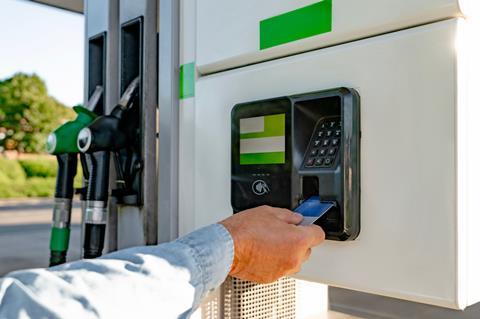
Both petrol and people are expensive and, with employee costs and fuel thefts skyrocketing, a growing number of fuel retailers are wondering if pay at pump could bring a boost to their business – either by improving security, extending opening hours or reducing staff costs.
But while pay at pump is a straightforward concept, it can be implemented in various ways and for differing reasons.
Here, we consider two takes on the topic, with retailers Goran Raven and Tom Highland giving their perspectives on integrating pay at pump into the traditional forecourt model.
New parents and 24-hour opening
Tom Highland, Highland Group managing director
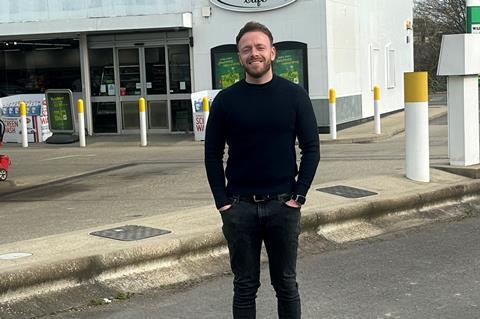
While pay at pump might initially be driven by the needs of retailers rather than customers, Tom Highland, whose firm operates five forecourts in the East of England, has found it to be a hit with drivers.
Having installed the facility initially to extend opening hours, and with a view to tackling drive-offs, Highland is finding that it’s actually seen as a bonus by some customers.
“When we introduced the system it was with a view to implementing 24-hour opening, with unmanned overnight, which I haven’t done yet due to other projects taking priority – but it gives us the option. I also chose to put it on my most vulnerable, roadside pumps.
“What’s surprised me is how popular it’s been with customers: roughly 20% of the people using the pumps we’ve put it on are choosing to pay at pump it,” he says.
Highland explains that parents of young children, and especially those with more than one child, like being able to pay without going to the hassle of bringing their kids into the shop, or weighing up the worry of leaving them in the car with the doors unlocked less the children set off the car alarm.
“Some customers have also fed back that they like not having to walk across the forecourt and interact with staff,” Highland says. While that might seem rather sad from the perspective of human interaction, he explains that this demographic is likely made up of people who suffer from social anxiety or are naturally shy. “Or just people who like to keep to themselves,” he adds.
For the moment, pay at pump is offered as an option on both sides of two pumps at St Neots, Cambridgeshire.
“Customers have the option of paying at the pump or coming into the shop to pay, but whichever they choose they need to select an option choice before the pump can be authorised. That caused a bit of confusion at first with people waiting for pumps without selecting their choice first, but people quickly got used to it.”
What about shop footfall, though? After all, the UK’s pay-in-store forecourt model is partly geared around using fuel to attract customers into the shop.
“It would be silly to say it won’t have affected shop sales”, Highland says, “ and it’s difficult to tell right now because we’ve been so busy this summer – but if it is affecting sales, it’s not by much.
“The only people whose custom you’ll miss out on would be people who didn’t plan to buy anything, but were tempted to make an impulse purchase when they came into the shop. And the flip side to that is I’m sure I’ve gained new customers who like paying at the pump.”
Drive-offs and tech issues
Goran Raven, owner, Raven’s Budgens Abridge
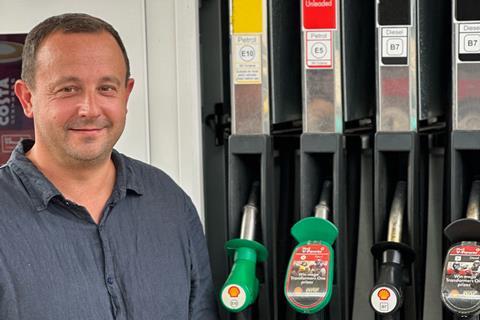
While Tom Highland installed pay at pump predominantly with a view to implementing 24-hour opening, Goran Raven’s choice to invest in the technology was driven more by the need to tackle drive-offs.
“I’m putting it on my most vulnerable pump, which is closest to my forecourt’s exit and is most often used for drive-aways, because we’ve got to do something about this issue,” Raven explains.
As with Highland, Raven is sourcing his pay at pump system via his epos supplier Madic, which works with a third-party firm to supply the tech.
Both Highland and Raven tell us the system is not cheap, coming in at about £5,500 for each side of a pump, plus a little extra for internal wiring. “But with each drive-off costing us £55 it shouldn’t take long to pay off,” Raven counters.
“Initially, we’ll be letting customers choose whether they want to pay at the pump or pay in store, but as the nights draw in we’ll be removing the pay-in-store option for that pump when it gets dark.”
Raven is about two weeks away from having the system up and running when we speak to him. He says he’s concerned about shop sales “and whether whatever money we save in drive-offs will be lost in revenue at the till from people not coming in”, but his ears prick up when we mention the customer feedback Tom Highland has received.
“I’d been so focussed on the drive-off angle I hadn’t considered some people might actually prefer paying at pump,” he says.
Raven has faced some delays due to the fact Shell dealers use a PIN pad and card machine supplied by the oil firm, meaning he has had to organise a new merchant to process payments from the on-pump terminal. He also thinks it will take a little time before the pay at pump option generates Shell Rewards points for customers with loyalty cards.
Those hiccoughs aside, Raven is looking forward to having the new facility and, like Tom Highland, has an eye on 24-hour opening.
“Looking ahead I’m thinking about implementing 24-hour fuel for this pump, but that would require CCTV monitoring and conversations with the council, so this is a longer term project.”