













For years, negative news stories about forecourt firms have been as regular and unwelcome as a teenager’s acne flare-up, but things are finally changing, with several fair, accurate and informed pieces appearing recently in the mainstream press.
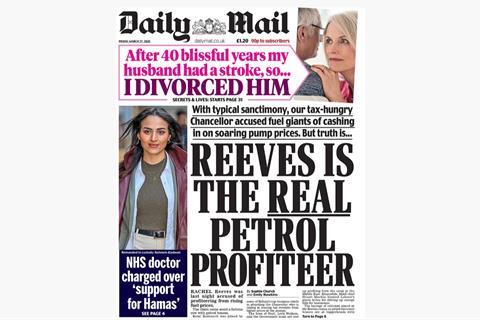
Just two days ago we reported on an investigation by The Times that found no evidence of profiteering in the sector, while today’s Daily Mail front page shouts REEVES IS THE REAL PETROL PROFITEER (their emphasis), mirroring an opinion column published by Forecourt Trader the week before last.
Around the same time, Energy Secretary Ed Miliband was left floundering on live TV after the BBC’s Laura Kuenssberg confronted his tiresomely familiar “price gouging” and “profiteering” jibes with a graph showing just how much tax the government gets from fuel sales.
The Telegraph, meanwhile, recently lambasted the government’s cost-of-living champion, Baron Walker of Broxton (one could hardly invent such ironically juxtaposed titles) after he spoke of “hauling” petrol retailers into Downing Street to give them “a shot across the bows”.
What’s brought about such a comprehensive change of tack from media outlets, which for years have been parroting lines about ‘greedy’ fuel retailers? Well, credit where it’s due, the Petrol Retailers Association has consistently fought waves of negative coverage, and has arguably had more success of late than it has in the past.
A good example of this can be seen when PRA boss Gordon Balmer brought about a change of political heart in real time, putting a cross-party committee member in their place when they wheeled out the old “price gouging” line, only for the MP to meekly ask “are retailers the fall guy?” after Balmer set him right.
We should not forget the role the RAC has played in creating this negative media landscape. For as long as I can remember the firm has been ignoring inconvenient facts to drum up press coverage for itself at the expense of fuel retailers – until another Forecourt Trader op-ed told it in no uncertain terms to cease and desist, which the breakdown firm seems to have subsequently done.
If you’ll excuse more shameless flag waving, this publication has done its bit elsewhere, too. My gaffer Juliet Morrison has long defended the sector, and was not only quoted in The Times’ recent investigation, but was interviewed on LBC to give forecourt firms a fair crack of the whip. A special mention must also go to retailer Goran Raven, who has repeatedly put himself in front of the camera to get the message across, while another forecourt player spoke out anonymously.
The biggest catalyst of change for media representations of fuel retailers, though, has been the government, whom we should all thank.
We should thank Rachel Reeves for her accusations of “price gouging”. We should applaud Ed Miliband for his talk of the fuel market “not working well”. We should express gratitude to Keir Starmer for his “rip off” jibes. And we should congratulate Baron Walker not just for his government appointment and the peerage that swiftly followed it, but for his muddleheaded screed that claimed retailers are “exploiting” drivers.
Why should we thank this sorry lot? Because their political ineptitude is such that they have achieved the opposite of their intended outcomes.
Rather than their accusations (which have been so consistent they must have been part of a coordinated strategy) resulting in negative press coverage for fuel retailers, thus diverting attention from disastrous energy and tax policies, they have instead seen journalists dig deeper than usual and discover that while forecourt firms make a 5% average margin on fuel, the government takes 55% of every penny drawn at the pumps.
So bravo, Keir et al, you have achieved a fortnight which the PRA and Forecourt Trader have been trying to do for years. By way of thanks, next time I fill up I’ll choose super unleaded rather than regular – you’ll get more VAT out of me that way.
