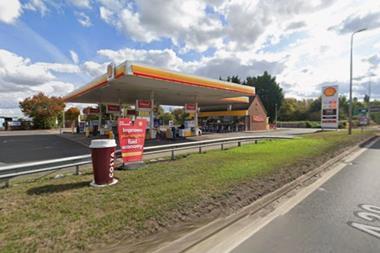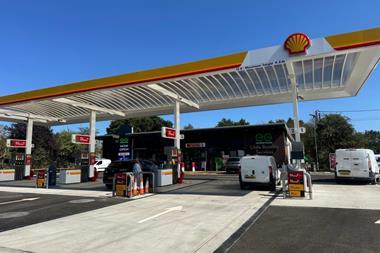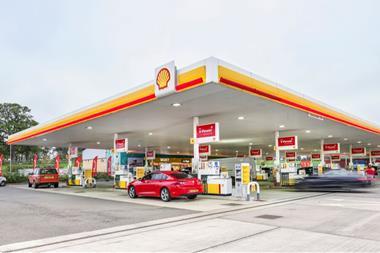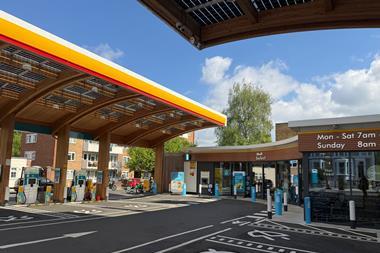













Forecourt Trader headlines would suggest that 2025 has been an annus horribilis for Shell: losing more than 125 MFG sites to rival oil companies and alienating others by revising terms amid fuel supply contracts.
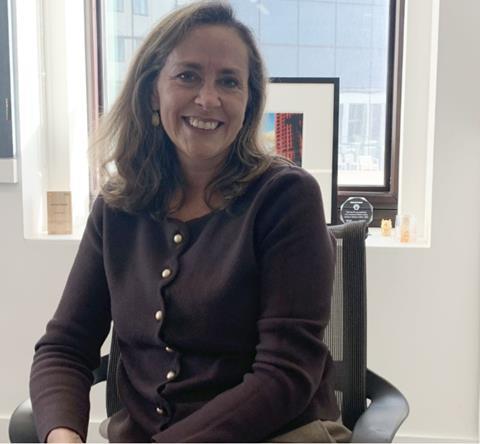
Not so, says Janine Albrecht, almost a year into her role as the oil giant’s general manager of mobility and convenience. She believes that hard decisions during that time have set the business and its 150 remaining dealers, with around 400 Shell sites, in good stead for the next 12 months and beyond.
While declining to comment on the reason for increases in what dealers must pay, Albrecht admits that losing so many sites from the UK’s Top 50 Indie, as well as contracts with industry heavyweights the Hockenhulls and Joseph Richardson, has been a blow.
“We love our dealers, but really this year we had to reset some of the really basic premises that we had,” says Albrecht in an exclusive interview with Forecourt Trader. “But I see growth with our dealers both in terms of numbers for the network, and of course opportunities we are creating for them,” she adds.
It is an ever-changing industry, with contracts coming up every five years, and Albrecht asserts that despite the forecourt losses this year, Shell maintains “a good relationship with MFG”. It will, she says, continue to tender for interesting sites belonging to the UK’s biggest independent network as its fuel supply agreements become available.
Certainly, the oil giant, which boasts the UK’s biggest company-owned network, has plenty in the pipeline to win over dealers. And, of course, the overriding attraction remains the long-standing magnetism of its heavily marketed V-Power premium fuel which benefits from its associations with Formula 1 and Ferrari.
The future
Albrecht, a lawyer by training, has worked at Shell since August 2000. Most recently she headed the commercial road transport department, and before that led the global digitalisation of Shell’s mobility business.
Significantly, says Albrecht, joining forces with Shell will put dealers at the front of the greener energy transition across road transport.
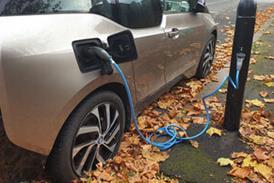
Next year it plans to roll out its Shell Recharge electric vehicle charging proposition from two to 12 dealer sites. And in February, it will start supplying half a dozen dealers, including Rob Exelby, with Shell Renewable Diesel branded hydrotreated vegetable oil (HVO), offering drivers a 90% carbon reduction over diesel.
Also, the Shell Go+ Rewards loyalty programme, which has 2.5 million users, is also being bolstered. Loyalty schemes are becoming ever important in fuel retailing with the rise of the convenience store on petrol sites, and Shell this year has enabled motorists to ‘burn’ as well as earn points at dealers as well as company-owned sites.
Points – based on purchases rather than previously on visits – can also now be accrued on the Shell Go+ Rewards app for EV charging. And last month the app was developed further for motorists to buy a £9.99 monthly subscription for charging, offering a 30% reduction in the cost per kWh. “We know that a lot of customers like the opportunity to charge very regularly at a lower price,” says Albrecht.
Now the business is looking at allowing motorists to earn points on anything purchased at a dealer site. Currently points can only be made on fuel, EV charging, Costa coffee, and Shell-branded lubricants, the latter of which have recently been made available to dealers.
“Loyalty is a really big pull for us,” says Albrecht. “We have a very loyal customer base who love the brand and customers don’t know whether a site is company or dealer owned, so it is important they can earn and burn the same at both types of outlet, and we have a great opportunity to grow that loyalty at dealer sites.
“Shell Go+ Rewards used to be a visit base rewards programme so every visit counted, but it was very complex for customers to understand and it was probably not found as engaging as other programmes, so October 2024 we moved back to points which is a currency that customers understand, really like and manage really well.”
Also coming are initiatives to give dealers greater benefits from the combined buying power of Shell and its 550 company-owned sites.
“Something I would like to see, and the team are working on this to identify opportunities, is where dealers can benefit from our economies of scale. I see opportunities where they manage their own shops which we could potentially help with, like we did with Shell lubricants.
“I’d like there to be modules that they can take, to stack up a richer and richer offer. A bit like we are doing with Shell Recharge, Shell Renewable Diesel, and Shell lubricants. This should be part of a wider proposition.”
This is all part of Shell’s aim at getting closer to the dealer, says Abrecht, which will be music to the ears of many in the Shell fold. For years, way before Albrecht’s tenure, the business has been viewed by many as unapproachable, some might say even arrogant, safe in the knowledge that the brand has the bargaining chip of V-Power which motorists, and often forecourt operators, will go out of their way for.
Staff restructure
But, says Albrecht, change is underway with the creation at the beginning of last year of a dealer specific team under the direction of Shell stalwart Chris Turner, who has been appointed dealer manager.
“A few years ago there was an internal reorganisation which meant that there was not a team dedicated to our dealers. Maybe that is why dealers have found that Shell is not as approachable or reachable. Our fantastic team was looking after dealer and company-owned sites which are much more intensive in terms of running and operating,” she explains.
“So we have made a huge effort now to close that cycle,” says Albrecht.
Turner’s team is made up of half a dozen account managers, and two business development managers, dedicated 100% to relationships with dealers, “to make sure that we can support dealers in a much better way”, says Albrecht.
Earlier this year Sue Annis moved from national sales manager to take on the challenge of UK business development and transformation lead. This involves integrating new site acquisitions into the business, and needed someone “very experienced” and with her specific skills in business development and transformation, says Albrecht.
Steve Bean, also a well-regarded name in the industry having spent a long time in the field, has been appointed national sales and operations manager – overseeing the company-owned and dealer teams.
Albrecht describes her management style as being “quite open” thanks to her Latin roots and Colombian heritage. She says: “I like to really embrace the input of experts who have been in the role for longer than I have been, and who really know their stuff. I like to turn input into action by taking ownership of issues and challenges and really make things happen.”
She also likes to be involved at ground level and has in the past year dropped in on over 100 Shell sites, setting aside at least one day a month to visit five to 10 company-owned and dealer forecourts a time, some of which will be unannounced.
“So I am very plugged into our frontline. I like the operational aspect, and I think retail is detail. I like seeing what customers see. By seeing the good, the bad and the ugly I can see with my own eyes where we can support dealers. The business is not in the office it is in the field. “
Move to electrification
A plug-in hybrid car driver herself, Albrecht is excited about the plans to roll-out Shell Recharge to dealers. The first forecourts to offer the service are Rob Exelby and the Kay Group, and another dealer site is due to go live by the end of the year.
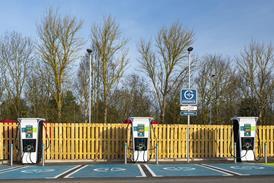
Shell has already tested the concept at its sites, and it operates over 1,000 chargepoints in more than 250 locations. By the end of the year it will have 893 DC fast chargers, with plans for another 55 this year, and 140 more in 2026.
Albrecht also enthuses that the Shell fuel card is now fuel agnostic – taking payment for EV charging, as well as HVO on pump, and the more traditional fuels.
Having led the charge with electric only forecourts with its first site in Fulham, London, it is now planning more with land purchased in Scotland and expectations to have the format live there in 2027/28.
Company-owned outlook
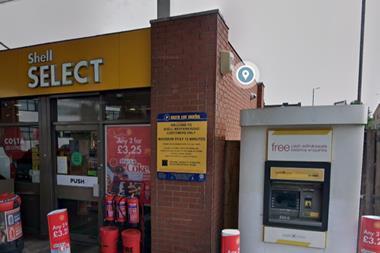
When it comes to the Shell company-owned sites Little Waitrose and more recently Shell Select Proud to Stock Co-op are the preferred shop fascias. This year there have been around 60 store conversions to the latter brand, with “more coming”, says Albrecht. The big attraction of both fascias is their emphasis on fresh, food for now and later, perishable ingredients.
Valeting is an area that the business is revisiting having in recent years replaced this revenue earning equipment with EV charging. But now with the reduction in hand car washes it is a facility that Albrecht wants on every one of the company-owned sites. “That would be the dream for me,” she says.
Unmanned sites, popular on the Continent, are also on Albrecht’s radar.
It has certainly been a busy year for Albrecht who maintains that she loves the job. And despite contending with some negative headlines in Forecourt Trader over that time, fuel volume for Shell has most importantly increased during 2025.
To celebrate Albrecht says that she is planning “something special” for the dealer meeting next year. She adds: “We have fantastic dealers who are pioneers, and who embrace opportunities, and we have so much more we can do together so that we both benefit from the partnership.”
.