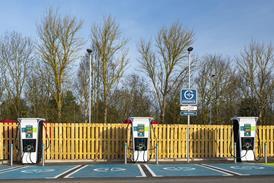

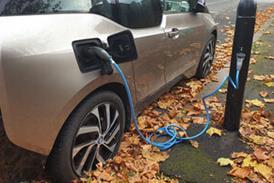

















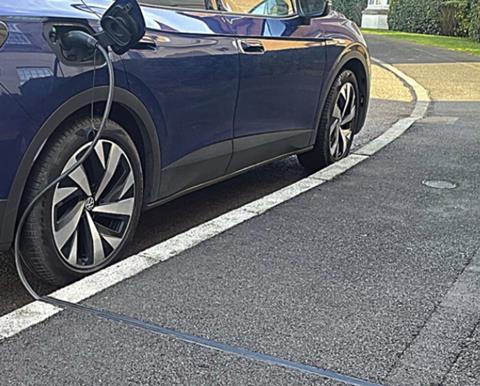
EVA England has launched a new national survey on cross-pavement charging to capture the real-world experiences of drivers without access to off-street parking.
The organisation says the survey follows significant recent progress in Parliament on tackling the UK’s growing “charging divide” – the cost and access gap between drivers who can charge at home and those who must rely on public charging – after Baroness Pidgeon secured two key government commitments during the passage of the Planning and Infrastructure Bill in the House of Lords. The Bill formally became law last week. The commitments include a formal consultation on extending permitted development rights to cross-pavement charging solutions and a commitment for ministers to write to all local authorities, urging them to use their own highways contractors to install these technologies – measures intended to reduce both costs and delays for residents.
These concessions were secured following sustained engagement on the Bill by EVA England, working alongside sector partners, including REA, New AutoMotive and Kerbocharge, as well as parliamentary supporters, to highlight the practical and financial barriers facing drivers without driveways and the role cross-pavement solutions can play in addressing them.
EVA England says that until recently, many local authorities were reluctant to consider cross-pavement solutions as part of their charging infrastructure mix. Drivers faced approval processes lasting up to 15 months and installation costs of up to £3,000, creating a significant barrier to switching to an EV.
Against this backdrop, EVA England is launching its survey to ensure that drivers’ experiences remain central as these policy commitments and consultations are turned into practical delivery on the ground.
Vicky Edmonds, chief executive of EVA England, says: “This survey is about making sure drivers without driveways are heard as government takes these commitments forward. Cross-pavement charging won’t be right for everyone, but where it does work it can unlock access to cheaper charging, lower running costs and one less barrier to switching to electric. We want government and local authorities to get this right, and that starts with listening to drivers.”