










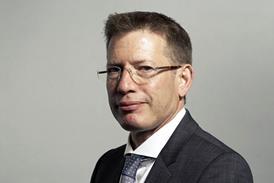
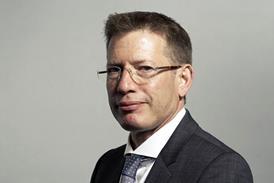


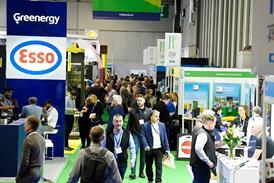
Rontec boss Sir Gerald Ronson is celebrating 60 years in the forecourt business, but the 86-year-old is far from calling it a day. In an exclusive interview at his plush Mayfair offices, he tells Forecourt Trader how he plans to take on more sites, invest in EV, and continue to spend his Saturdays checking in on his commission operators.

Everyone who has spent time in the industry has a story to tell about the godfather of petrol retailing, Sir Gerald Ronson CBE, who this week marks 60 years in the vanguard of the sector. Rarely talking to the media, he likes to keep as low a profile as his reputation allows.
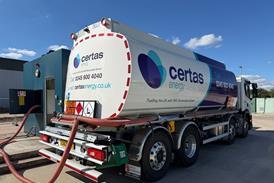
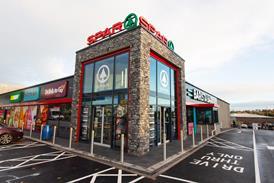
This has created a mystique and string of urban myths around the still-energetic 86-year-old, who built the £2.1bn-turnover Rontec Roadside Retail forecourt empire from a single site in St Albans. With its 267 petrol stations across the UK, all run by commission operators, it is the second biggest independent operator after MFG.
One of the most fantastic tales circulating the forecourt world is that Sir Gerald embarks on his weekly store visits with a ‘spare’ manager in his chauffeur driven car. It means that if a dirty toilet is detected, a magazine missing from a display, or bread merchandised out of planogram, the hapless commission operator can be replaced on the spot with Sir Gerald’s travelling companion.
So goes the rumour anyway. Another of the more outlandish yarns is that the Rontec boss once arrived at a potential acquisition viewing, after being urged by the agent to remain low-profile, in a stretch limousine and with a convoy of black Mercedes cars.
Legends aside, there are many undisputed facts surrounding Sir Gerald’s remarkable contribution to the industry. He is renowned for introducing cut-price petrol to Britain, not to mention self-service petrol stations, canopied forecourts, convenience outlets and even off-licence sales – all ideas that were quickly adopted by his peers.
Today, he continues to command the respect of his counterparts, with a financially robust privately owned business that is debt-free, announced record £98.4m pre-tax profits last September, and accounts for 5% of the overall UK retail fuel market.
Describing running Rontec as his “hobby”, Sir Gerald spends part of his six-day working week on charity activities – to which he donates millions a year – and running Heron International, an international property business with a portfolio worth over £500m, which he largely owns, and is best known for the City of London’s 46-storey Heron Tower.
He describes Rontec as “a unique business because of the size of it and being a private company owned directly and indirectly by yours truly,” adding: “We have no debt and are sitting on £300m, maybe £400m of cash. I don’t have a site that doesn’t make money, as I have got rid of everything that doesn’t make money.”
The structure of the company is somewhat unconventional, with roughly a third of the enterprise owned by Sir Gerald, his wife Gail, and four daughters in the Ronson Family Trust, with the separate charitable Gerald and Gail Ronson Family Foundation owning two-thirds. “There is over £1bn of value in the Foundation.”
Sir Gerald entered petrol retailing after setting up the Heron property business with his father, who he says was a “tough individual” who originally had a carpentry business that Sir Gerald joined after leaving school aged 14. He credits his father for his business discipline and says that he is a “chip off the old block”.
After his successes in property, which had made him a millionaire by the age of 25, economic difficulties in the mid-1960s prompted Sir Gerald to look at petrol retailing to “tide Heron over”. Thus began six decades of buying and establishing petrol stations – more than 1,000 in total – and divesting many of them. They include 810 Total Oil forecourts purchased in 2011, 254 of which he divested to Shell. He also snapped up 40 Co-op sites in 2016.
His emergence in the industry back in the mid-1960s was instant. After one year he had 12 sites, and within two years 25. At one point he was opening or building a site a week. Of course, it was a different industry back then, with 38,000 forecourts across the UK, many of them comprising a couple of pumps and a kiosk selling cigarettes, confectionery, and the odd car accessory.
Ronson – as he was then – was on a mission to transform a staid sector, taking his inspiration from the USA, which at the time had larger outlets with an emphasis on customer service – although he did pioneer self-service pumps – and establishing loyalty, with promotional campaigns to give away the likes of drinks glasses. His version was Heron Stamps, the first loyalty programme in petrol stations, although Green Shield Stamps was already established in the UK.
He also believed that one feature would lure motorists to his forecourts – cheap petrol. From the beginning, he was determined to sell his petrol cheaper than his competitors. And six decades on, he still prides himself on being competitive on fuel, with prices typically only 1p or 2p per litre higher than the supermarkets.
In 2026, Rontec’s strong balance sheet means it is able to grow without having to source external capital. This year it has been advertising on Forecourt Trader for site acquisitions. It has eight new-to-industry petrol stations under construction, and a programme to triple the size of 12 of its forecourt shops.
Rontec states in its adverts that potential acquisitions should have a 3.5mlpa fuel volume, shop sales of £500k-plus, and at least a half-acre plot. “We are in the market for more sites, and we could make immediate decisions to buy something,” says Sir Gerald.
He insists that growing the portfolio is very much part of Rontec’s strategy. “I am not sticking at 270,” he says. “I would be happy if I could get another 500 sites, but they have got to fit. I’d like as many as I can get but getting them in the right location with the right franchise is difficult.
“We want big sites, shops of a minimum size of 3,000sq ft, to fit our blueprint of a proper convenience store, proper brand and proper focus on pricing and marketing, that are open 24/7,” says Sir Gerald. In fact, 90% of Rontec sites are open around the clock.
“We could do any size deal if it’s the right deal for the company, and we only want large sites – because that is where the future is.”
Currently, the business has around 70 smaller Shop’n Drive locations which may not fit with the big-is-better strategy, but they still generate an income and there are no plans to dispose of them. “I could sell them and make a profit, but I don’t need the money,” he says.
At the other end of its portfolio, Rontec has 100 to 120 ‘A-sites’ that Sir Gerald says “are all singing and dancing with a fuel volume of 150,000 litres a week, and a shop at £30k to £40k a week, with proper margins.”
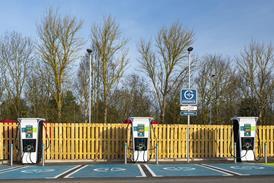
Despite admitting to being “very anti-electric car” himself, Rontec has earmarked tens of millions of pounds for ultra-fast electric vehicle charging hubs. Sir Gerald’s reasoning is that while “you can’t make any money currently out of EV, you need it for the future”.
The business has six sites with EV chargepoints, with another 12 due to go live this year. Sir Gerald says Rontec is “in planning” to install EV on 200 sites: the remainder are too small. Half of those 200 sites have been given planning approval for the installations during the past two years.
Although, EV uptake has been slower than many in government and the EV manufacturing sector might have hoped, Sir Gerald, who caustically describes the various government’s efforts for the electric transition as “a disaster”, is preparing for a scenario in which EV sales increase strongly. “If all changes we are in a position to do it, and we have the money to do it,” he insists. “I would say in five years between 50-70 of our sites will have EV – we will make the investment if we can make the return.”
EV is just the latest in a long series of investments and innovations from Rontec. Spending heavily on the estate remains vital for the business. Last year the company invested £25m on updating the sites – 85% of which are freehold-owned by Rontec – including a programme of spending £30,000 per store on more economical refrigeration with doors, which will be complete this year. Another £10m went on extending the size of the shops. “That is a lot of money, but adding to the value of the real estate,” he explains.
Last year, property agent Colliers added £318m onto the valuation of Rontec’s estate, taking it to £1.51bn, partly because of investment in site improvements.
Rapid depreciation of equipment is also part of the model. Fuel pumps are written off over 10 years, instead of the industry norm of 20 years, and car wash equipment in seven years. “We spend a lot of money and have an accelerated write-off programme because it is the quality of the site, knowing that the equipment will not break that is important,” he says.
“We spend more money than anyone else in the industry per site and are known for the quality of what we build,” he maintains. “It is important that when you go to a Rontec site, every element is working.”
So, what is next for a business that has invented almost everything?
Valeting has been earmarked for growth. Currently the business has 167 rollover car washes and 100 jet washes. “Car washing is a very profitable element because with drive thrus you can do £2,000 a week. Rollover plus jet washes work,” he says.
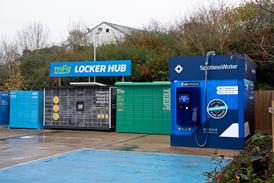
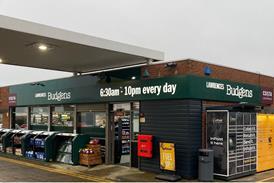
The business has identified a new revenue stream from installing phone masts at his sites for mobile phone networks in areas which have a weak signal. And it has also a strong parcel locker footprint with Amazon (220 units), InPost (180), and Quadient (147).
Also, most of his forecourts offer home delivery (217 Deliveroo, 213 Uber Eats, and 223 Just Eat). “We were doing home deliveries 24/7 before anybody had even heard of home deliveries,” maintains Sir Gerald, with sites turning over £2k to £3k a week from the service.
“I am not saying that everything we do is fantastic, but you need to create mini hubs on large sites with six charging stations, proper car washing and a couple of bays of jet washes,” he says.
While some of the reports of Sir Gerald’s in-person surveillance of his network might be exaggerated, it is true that he keeps a close eye on business. In fact, he typically spends Thursdays and Saturdays on site visits. This can mean travelling by private jet, to ensure he fits in as many locations as possible. “I see 25 sites some days,” he says.
Local managers do get a warning of Sir Gerald’s approach – and a chance to fix anything that might incur his wrath. “There would be an explosion” if anything is found out of place, he admits.
“I learnt from Lord Marcus Sieff, a mentor and former chairman at Marks & Spencer, that retail is detail in this business, and I know exactly where everything should be,” he says.
“When I arrive at a site I walk around outside to check it is all clean and swept, and if there are gardens I check to see if they need seeding or whatever. The first thing I do in the shop is to go to the toilet, and God help everybody if those toilets aren’t spotless. They need to smell nice, have soap and toilet paper, with staff signing in every hour so that it is regularly inspected.”
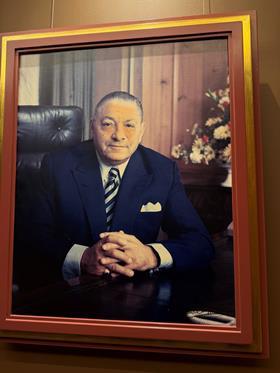
Former Rontec commission operators who have gone on to buy their own forecourts now preach these standards themselves, and recount stories with affection of when they were caught out by Sir Gerald. He admits that he “can be brusque and tough”, traits undoubtedly passed down by his father, who looks across to Sir Gerald from a painting in pride of place in Rontec’s boardroom.
Most of Rontec’s managers have been at the business for five to 10 years, says Sir Gerald. “It’s known in the industry if you can survive in Rontec for 12 months you will be there for life,” he laughs. His righthand man managing director Giles Taylor has been with him for 33 years, and operations director Nick Lowe for 20 years.
One director told Forecourt Trader that while Sir Gerald does not suffer fools, “he will give staff their own fishing rod so that they can get on with the job for themselves, rather than fishing for them”.
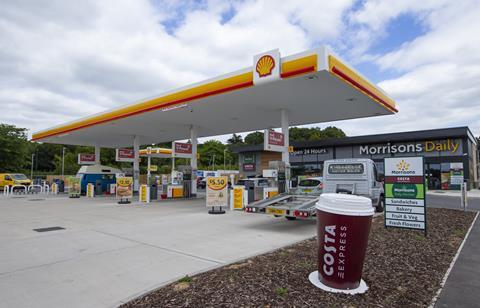
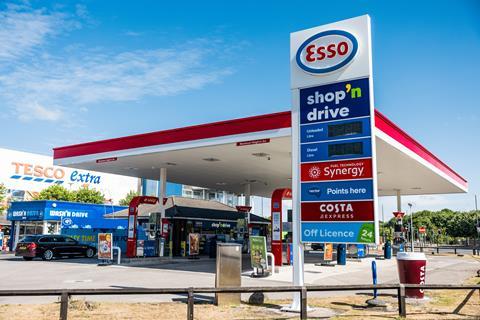
Esso remains Rontec’s biggest fuel supplier, with 194 sites under that brand. BP with 65 and Shell (eight) make up the rest. He is also happy with his long-term relationship with Morrisons, whose fascia is on more than 100 of its forecourts. Subway and Greggs have been Rontec’s main foodservice brands, but he is looking at bringing in new partners.
Looking back on his six decades in the trade, he says he is proud of his role in transforming the humble British petrol station of the 1960s and 1970s into “roadside retail”.
Of course, there have been bumps along the journey. In the 1990s, he spent six months in Ford open prison for his role in the Guinness share-trading scandal, an experience that he says helped renew his Jewish faith, although it could have prematurely finished his business empire. “Some people imagined that when I came out of prison the world would look at me like a leper. They urged me to go and live abroad,” he recalls in his autobiography, Leading From The Front, published in 2009.
He now claims to have “the soundest business in the industry” with an unrivalled network of sites spanning the length of the country. He has no plans to call it a day.
“I can’t control the good Lord if he decided enough is enough. But I am not planning to go anywhere abroad, and I am not planning to retire because I love what I do.”
Sir Gerald Ronson: a life in petrol retailing
- Sir Gerald Ronson was born in London in 1939, the grandson of Jewish immigrants who came to England around the turn of the last century from the Russian empire.
- He grew up in Hampstead, failing his 11-plus examination. But by the time he was 25 he was a millionaire.
- Quitting school at the age of 14, he worked in his family’s furniture factory.
- After selling the factory to a mail-order firm in 1956, his father moved into property setting up a 50-50 partnership with Sir Gerald, one of his two sons, and Heron was born.
- In the early 1960s Heron moved from domestic properties to small supermarkets and retail developments – eventually having commercial property in 52 towns throughout the country.
- The UK’s economic slowdown in 1964 was the catalyst for Sir Gerald to discover petrol stations, to generate enough cash to “tide Heron over”.
- He bought his first site in April 1966 at Marshalswick Lane, St Albans, when there were around 38,000 filling stations in the UK.
- After his first 12 sites were up and running he introduced the first self-service station. By the end of 1969, there were 66 Heron stations, 35 of them self-service.
- In 1990 he went to prison for six months for his involvement in the Guinness trading scandal. This was followed by a major financial crash that nearly bankrupted him. While in prison the property market was starting to falter, prompting him to sell 150 petrol stations to Elf for £150m.
- In 2005 he launched the new Gerald and Gail Ronson Family Foundation in which all of his Heron shares are bequeathed. It has given tens of millions of pounds to good causes.
- Sir Gerald Ronson was appointed a Commander of the Order of the British Empire (CBE) in the 2012 New Year Honours list. The honour, recognised his services to philanthropy and charity.
- In 2024 he was awarded a knighthood in recognition of his contribution to British life, and his decades of service to charitable causes.
- Sir Gerald still lives in London in the same house he has owned since the late 1960s, with his wife Gail, with whom he has four daughters – Lisa, Amanda, Nicole and Hayley – none of which he says will want to take the reins from him.