Highway Stops Retail’s fourth electric vehicle charging location has gone live, as the Top 50 Indie trials a suite of options under its Stop & Supercharge brand.
After more than a year of considering its EV strategy, the Wembley-based forecourt operator has over the past few months invested more than a half a million pound in the technology.
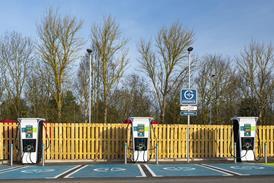
Most of that outlay has been spent at its BP Astwick Service Station on the A1 northbound near Hitchin in Hertfordshire, where it has four 400kW DC fast chargers from Finnish supplier Kempower.
These under-canopy units connect to a distributed charging system which means the chargepoints take power from a series of remote boxes so that two vehicles using the same unit will not be limited on kilowattage.
“The actual charger is a plug-in dispenser of power, not a live piece of equipment itself. It means that everyone can be charging at the level they need,” says Highway Stops’ non-executive director Ramsay MacDonald.
“With the distributive power model, a bigger car can be charging at 250kW and everyone else charging at their level,” says MacDonald. “The equipment gives faster power for chargers that need it, rather than using up power for those that don’t.
“Despite needing more space for the chargers, inverters, the LV connection and power modules themselves, we felt that this was the right approach for a busy A-road location.”
Most recently, at the end of March, it equipped its BP petrol station in Erith in south-east London with four 150kW DC Swarco chargers.
And it has introduced a 200kW Alpitronic DC chargepoint at both its Shell site in Amersham, Buckinghamshire, and at its BP forecourt in Lye, Stourbridge in the West Midlands, with Clarke Electrical Industries behind those installations.


Highway Stops was in the fortunate position of only having to make a “limited investment” to upgrade the previous substation at Astwick, with the other sites avoiding the need for outlay on this big expense infrastructure.
Its striking black, orange and white EV charging branding is inspired by the operator’s Stop & Superwash canopy concept for valeting introduced a couple of years ago.
The approach appears to be striking a chord with customers, with Astwick in the first couple of weeks of installation seeing more than 10 cars using the chargers daily. The kWh price of 65p is below the industry average.

“We have gone at a compelling price to make it interesting to people and we are on track with where we thought we would be,” says MacDonald. “Every day we are seeing more and more customers.”
The business used the Evenlode Edison scoping service to determine which of its 14 sites would be best suited to EV charging. MacDonald has previously been a consultant to the company, which forecasts how many motorists will need charging in an area in five, 10 or 15 years, and predicts their likely dwell time to cross-sell convenience, valeting and other retail services.
Highway Stops is using back-office EV charging management platform Fuuse, which includes a motorist app and EV charging payment system. The platform gives Highway Stops insights into EV drivers’ buying behaviour, opening the possibility for a loyalty scheme and dynamic pricing.
It also means that Highway Stops can accept payments from major EV charging cards, including Allstar and Octopus Electroverse. Its sites have been added to EV charging hub mapping service Zapmap.