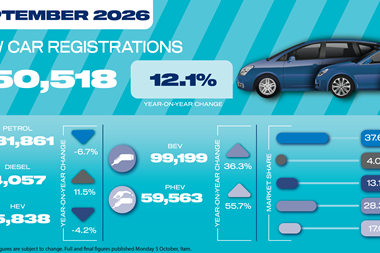






















July’s new car registrations were the best since 2019 thanks to a huge jump in EV take-up, yet the latest industry outlook shows sales will still not meet the 33% mandate target.
Society of Motor Manufacturers and Traders (SMMT) figures reveal that Britain’s new car market grew 11.7% in July, with 156,571 units registered.
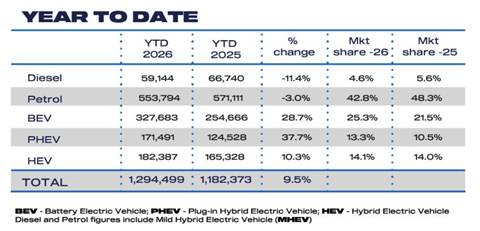
Growth was driven by EV uptake, with plug-in hybrids up 33.6% to take a 14.9% share of the market, and hybrids up 11.6% to account for 13.2%. Battery electric cars (BEVs) achieved another record volume for the month, up 44.5% – compared with a sub-par July 2025 when some buyers delayed switching until confirmation of full model eligibility for the Electric Car Grant (ECG) – to claim a 27.5% share.
The latest industry outlook now expects BEVs to reach 27.4% of a 2.18 million-strong market by year end – up from a 26.8% share in April’s outlook but still far short of the 33% mandate target.
Longer term, BEV share is expected to rise to 32.1% in 2027 against a target of 38%. The SMMT says this is despite an ever-expanding number of brands and models, manufacturer subsidies, government incentives and an ongoing backdrop of high fuel prices. The outlook reflects manufacturer views submitted prior to the end of ECG eligibility for demonstrator and courtesy cars in mid-July. Given these vehicles currently account for around 10% of BEV registrations, and around a third of the BEV market is delivered through the ECG, the change could impact future performance.
Mike Hawes, SMMT chief executive, says: “July’s record EV performance is a great achievement, reflecting industry’s huge investment in zero emission mobility. But that progress cannot be sustained if manufacturers continue haemorrhaging billions in EV discounts, distorting demand to avoid even steeper penalties. The sector’s commitment to decarbonisation is not in doubt but its ability to remain viable – and attract investment for an EV future – is under intense pressure. A sustainable transition will not happen merely by compelling supply when underlying demand is not keeping pace despite year-on-year growth. We need urgent reform of the regulation, else Britain risks undermining its competitiveness and the jobs and livelihoods that depend on this industry.”