
















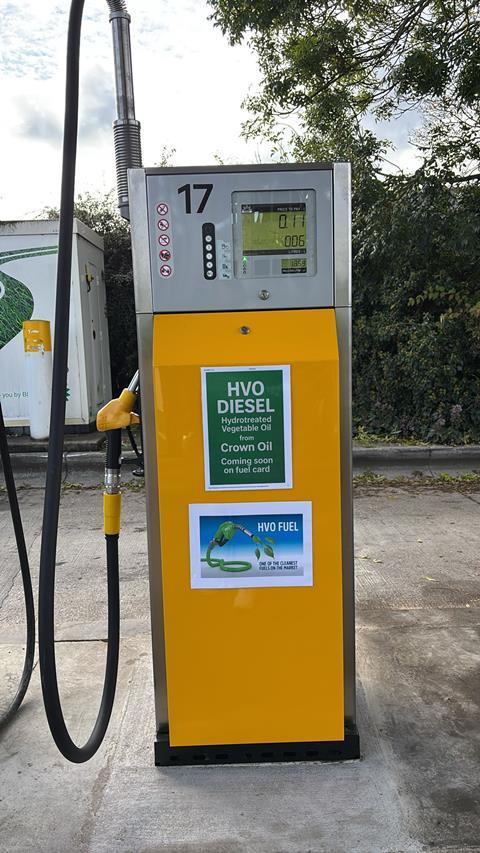
Nine-site operator Sectorsure No. 10 has installed hydrotreated vegetable oil (HVO) at its BP/Londis Rivenhall forecourt on the A12 in Witham, Essex, which sells over two-thirds of its fuel volume to truck drivers.
Inspired by industry trailblazer and Forecourt Trader of the Year 2025 David Charman, the Top 50 Indie has invested £30,000 in the project.
“We thought David’s decision to put HVO on pump at his site was brilliant and with 80% of our diesel sales from truck drivers we wanted to offer our customers a greener alternative fuel that can help cut up to 90% of net CO2 emissions,” says Sectorsure No.10 managing director Lewis Trevellyan.
The company has purchased a P1000R pump and 5,000 litre bespoke above ground tank from Petroassist and the investment included electrical wiring, pipework, new bollards and groundworks carried out by Adam Major at DM Petroleum Services.
Sectorsure No. 10’s BP forecourt is one of around 49 public facing HVO refuelling stations, including truckstops, according to MyAutomate which is putting together a directory of these sites.
MyAutomate, which operates the PetrolPrices.com app for motorists to find the cheapest fuel prices in their area, hopes to launch its mapping service by early next year.
It believes that by including HVO on pump as a separate fuel grade on PetrolPrices.com that it would be a boost to petrol station operators like Sectorsure No.10 thinking of getting on board with the diesel replacement for cars, vans and trucks.
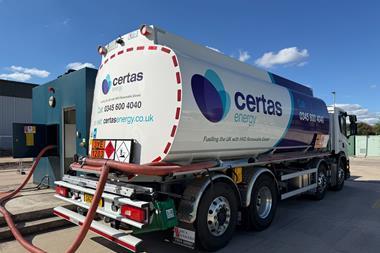
BP Rivenhall gets its HVO from Crown Oil, whose environmentally-friendly alternative to diesel has been approved by the Zemo Partnership’s renewable fuels assurance scheme
The operator has been alerting local hauliers to its new service on Facebook urging them to “Be part of the green revolution and try a fill up now.”

Trevellyan says that he wanted to support a fuel which is essentially “homegrown green diesel, produced in the UK but not readily available publicly.”
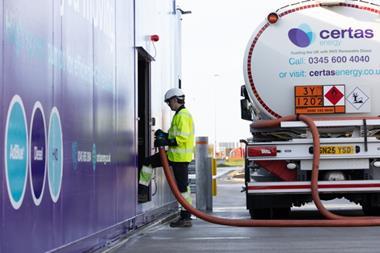
The addition of HVO on pump under a canopy for HGV drivers, with AdBlue and diesel, is part of an upgrade at the 24-hour site for truck drivers. In the last couple of months the company installed two P2000 high speed HGV pumps from Petroassist, which dispense 130 litres a minute instead of 70 litres from the equipment they replaced. “We wish we’d done this sooner as it gets trucks off of the forecourt much quicker, reducing problems with queues,” says Trevellyan.
But the timing has been difficult he admits when it comes to the introduction of HVO on pump at BP Rivenhall, with the spot market for HVO “rising sharply in the past few months”. For now he is retailing HVO at 177.9p per litre, which compares with 147.9p per litre at the site for BP standard diesel and 163.9p per litre for BP Ultimate diesel.
Trevellyan is hopeful, however, that prices will fall back to a more affordable level. “We expect the price to settle down in the new year,” he says. ”It would be great to see the government look at reducing the VAT rate on HVO down from 20% in the upcoming Budget to drive adoption,” he adds.
David Charman agrees that the government needs to support the use of HVO as a diesel replacement by helping to reduce the price differential between the two fuels.
“HVO remains slow. We have a few dedicated car customers, however most sales are with HGVs unable to get back to their depot to refill,” says Charman.
“I remain hopeful that the government will not increase duty on HVO and thus bring the price nearer to standard diesel.”
Meanwhile, fellow forecourt operator Joseph Richardson has also taken the leap with HVO installing three pumps in the HGV area at his flagship site Goole, in East Yorkshire, in the past two years. He says: “It is doing well but almost exclusively off the back of one customer.”
According to MyAutomate subsidiary Portland Pricing, which monitors wholesale prices of HVO, in early 2025 there were periods when HVO and diesel traded at near parity after considering the Renewable Transport Fuel Certificate (RTFC) value.
Since March, however, demand for HVO has surged while supply has struggled to keep pace. Prices have climbed by more than 50%, even as diesel benchmarks have softened amid the unwinding of OPEC+ production cuts and weaker economic indicators, says Portland Pricing. As a result, in mid October for example, HVO was trading around 50 pence per litre higher than diesel, after the value of the RTFCs had been taken into account.
While diesel pricing remains tied to crude oil and OPEC+ production decisions, HVO’s price is shaped by biofuel feedstocks, sustainability rules, and policy incentives, explains James Hitchman, operations director at Portland Pricing.
”The EU’s Renewable Energy Directive III (RED III) has intensified competition for waste and residue feedstocks by raising renewable transport targets and tightening greenhouse gas (GHG) reduction thresholds. Producers and traders are racing to secure compliant materials, driving costs sharply higher,” Hitchman says.
At the same time, the UK’s alignment with RED III principles through its Renewable Transport Fuel Obligation (RTFO) continues to support HVO demand, especially for waste-derived grades that qualify for double RTFCs.
”But with limited domestic production and growing regulatory compliance costs, prices are expected to remain elevated through the winter. Unless new capacity or imports ease supply pressure, the HVO premium over diesel is likely to persist into 2026, reinforcing its position as a cleaner but costlier alternative for UK transport and heating markets,” says Hitchman.