



When you produce six billion litres of oil a year it’s easy to see how something that’s sold in small, disposable cups can get overlooked, but BP has decided it’s time to pay its coffee some attention, giving its other black gold its biggest update in a decade.
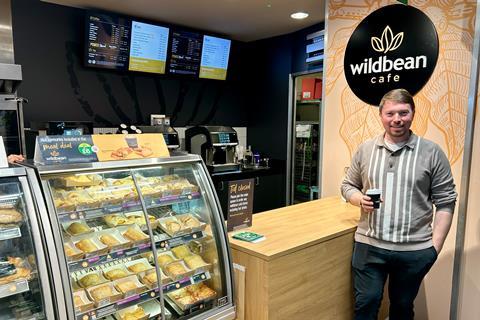
“We put the entire bean supply contract for all our forecourts out to tender,” BP’s senior proposition development manager Tom Campbell-Rawlinson tells us as he sips a cup of Wildbean Cafe coffee at one of the firm’s company-owned sites in North London.
That contract was ultimately won by Lincolnshire roasters Lincoln & York, who now supply BP with a 100% Arabica blend, introduced at all UK Wildbean sites in late September this year.
“Before, I’d say our coffee was…fine,” Campbell-Rawlinson admits. “It was okay, it was mid-range. But now we’ve got a speciality coffee that’s richer, fuller, and we’ve introduced it at every Wildbean Cafe.”
Those Wildbean Cafes – split across 300 BP-owned sites and 75 dealer forecourts – all now serve coffee brewed with the new beans, regardless of whether they are made by staff at a full serve-over counter (just 13 dealer sites have these), or are dispensed by customers themselves via self-serve machines.
The company operates around 600 coffee machines, and each required adjustment by an engineer to get the most out of the new blend, achieved partly by dispensing more coffee with each drink to increase flavour and strength.
Another change implemented across the Wildbean estate concerns milk, with whole replacing semi-skimmed as the default offering, and semi replacing skimmed as the lighter choice.
“Whole milk has slightly higher fat content but it makes better coffee – it’s a richer, smoother drink, and it’s more consistent,” Campbell-Rawlinson says. “We still have semi-skimmed for people who want a lighter option, but we don’t offer skimmed because its low fat content means it doesn’t make a great coffee.”
New coffee and milk form only part of the upgrade picture, though, and Campbell-Rawlinson is heading up a wider improvement package that’s expected to take three to five years to implement across all Wildbean outlets.
The Mill Hill forecourt where we meet is one of 46 company-owned sites selected to make up the first phase of this plan, which has seen it decked out with a freshly designed serve-over counter complete with updated wall art, tiles and counter, alongside a refreshed logo.
More significantly perhaps, these 46 forecourts also get new coffee machines, with BP going for Swiss-made Eversys Cameo Classics. Campbell-Rawlinson is understandably reticent about how much the firm paid for these (“you’ll have to ask Eversys”), but a quick dig online indicates if one thinks in the £20,000 range one wouldn’t be too far off – bulk-order discounts to kit out 46 sites notwithstanding, naturally.
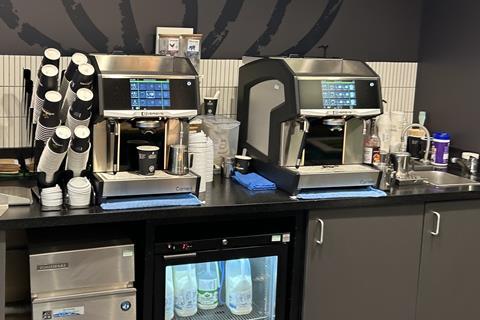
Those Cameos are hybrid machines, taking elements from fully manual and fully automatic devices, removing the need for to fill and attach portafilters (into which coffee is measured and tamped before being hooked up to a machine), but doing everything else as the traditional way, with milk blended manually and separately, rather than coming out of the same computer-controlled spout as it would with an automatic machine.
A new ‘Power Blend’ option has also been introduced, which, for a 50p upgrade, sees brews made with a 100% Robusta bean, famed for having around twice as much caffeine as Arabica.
The coffee, décor and tech have all been upgraded, but people haven’t been forgotten: staff at phase-one sites have all received three hours’ training on a range of topics including how to make the perfect coffee, and how to decorate the drinks with latte art.
Campbell-Rawlinson, who joined BP in December 2025 following several years with Marks & Spencer observes: “One of the things that struck me when I joined BP was how passionate staff are about the food and coffee they serve – they really care. Some were already making their own latte art, and the training was very well received.”
Another positive he notes is the unique proposition BP’s café brand, launched at the turn of the millennium, represents. “Wildbean is tailor-made for forecourts – it’s a format that is specifically designed for the types of quick visits people make to petrol stations.”
A self-confessed “geek” when it comes to coffee and the machines that make it, Campbell-Rawlinson says BP dealers who are interested in hosting a or machine should speak to their account managers. “We want out dealer partners to pick this up, and they’re already showing interest”.
And those dealers may have good reason to show interest: although the updates have only been live for a month and a half, every indication has so far been good. “It’s really early days – we rolled these improvements out on 29 September – but we’re already seeing increased coffee volume, and anecdotal feedback from customers has been really positive.”
Which brings us neatly on to what BP’s new coffee is actually like. Well, our yardstick is a small independent Portuguese café in south London that does everything manually and serves a double espresso so rich you’d swear you’d eaten a meal after drinking one, and so strong your palms will be sweating and your eyes twitching after two.
Given Wildbean sold 17.7 million cups of coffee in the UK last year, it’s hardly surprising the double espresso we sample is a little less punchy than the drink described above – this has to be a crowd pleaser, after all – but it’s impressive nonetheless: full bodied with a distinct but not aggressive flavour and a clean aftertaste, it’s a thoroughly decent cup, and better than the brews one gets from a number of big name-brands whose main business is one of BP’s side quests.
It also perks us up enough that on the train ride home we try to work out how much coffee BP would have to serve to equal the returns it makes from its main business, and come up with a figure somewhere in the neighbourhood of four billion cups. This may seem a fanciful endeavour, but it’s not that far removed from the firm’s own thinking:
“We’re an oil and gas firm,” Campbell-Rawlinson says. “But we also run cafes and sell coffee, and that can have a halo effect – a really good coffee offering can lift the shop and the customer experience, which increases shop returns while also boosting the brand; it all anchors back to our core downstream business.”