


















The first instalment in our series looking at forecourt design, construction and business planning sees us head to a forthcoming EG On The Move site in Chepstow
While some operators will be closely familiar with the processes involved in forecourt construction, others take a more hands-off approach, while new projects and knock-down rebuilds can be unfamiliar to newer and smaller firms.
To get an understanding of the work that goes on behind the scenes before opening day we headed to Chepstow, just over the River Severn in Wales, where EG On The Move is building a new-to-sector filling station complete with EV charging and drive-thru café, a stone’s throw from Junction 2 of the M48.
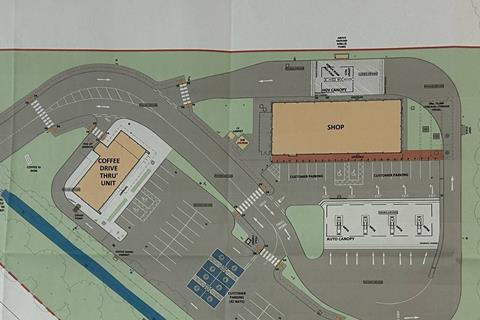
The project is being undertaken by AKN Build, whose commercial director, Richard Quarmby, says the Chepstow site is notable for relatively challenging soil conditions, something we encounter as soon as we step onto the red, clay-like soil, which seems to stick to everything it touches.
Quarmby says access to the site was also tricky at first, with the site manager for the project, Paul Short, telling us the first job was to make the site accessible for his crew.
“We turned up and had to take out three trees, reduce the ground, put a temporary pipe in where there’s a ditch, sculp it all up and build a temporary access onto the site.”
Initial works
That temporary access comprises a fully asphalted apron that gives way to crushed-stone car park for workers’ vehicles. A pair of stacked portacabins host a kitchen and canteen area on the ground floor, with a site office sitting above. A separate washroom portacabin completes the home comforts, while a solar-panel array provides power. It’d be a stretch to call the setup luxurious, but it’s far from uncivilised.

With all that done, the actual business of building can begin. We arrive about four weeks into the project, and Short describes the work that’s taken place so far.
“We’ve already dug the tank farm, got the three tanks installed, backfilled and shingled that, dug the footings out for the shop, canopy bases and Starbucks, and now we’re going to get them concreted up.”
Richard Quarmby says that some forecourt firms like to be on site to see “key installation phases” such as the tanks going in, but otherwise a monthly site visit is considered the norm, with contractors providing weekly updates over the phone or via email.
Short adds that installing the fuel tanks is generally one of the first jobs to take place during forecourt construction, as their size makes manoeuvring them into the ground tricky if other works have already been carried out.
Civil engineer Jamie Bray tells us this project is relatively straightforward compared to others, as the filling station is being built on what was previously a field.
“There’s nothing better than a greenfield site. There’s less risk in the ground to worry about.”
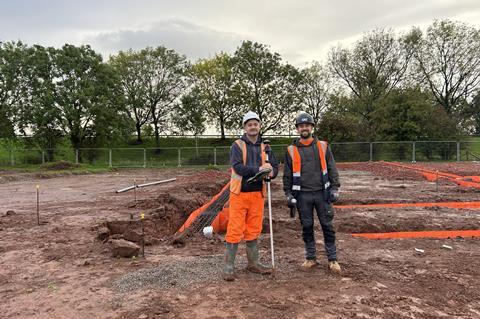
That’s not to say it’s all been straightforward, though: Richard Quarmby says utilities’ infrastructure for Chepstow are “over half a mile away from the site”, while gaining Sustainable Drainage Approval – a key planning requirement in Wales – was also challenging.
Concrete and bolt boxes
Concrete is the name of the game today though. Around 100 cubic metres, weighing roughly 200 tonnes, of heavy-duty, high-strength C35 concrete (ordered as a ‘pump mix’ so it pours easily) is set to be delivered by a trio of mixer trucks working on a turnaround basis, with once truck heading back to the plant to refill once it has has deposited its load.
That concrete is going be poured into the footings for the canopy legs and the shop’s ring-beam foundation, which makes up perimeter of the building-to-be. The Starbucks’ footings are for tomorrow.
Once poured into the footings, which into which steel rebar cages have already been installed, a series of ‘bolt boxes’ will be set into the concrete. Each box comprises a set of bolts held in formation by chipboard, which will later be removed, while the bolts have squares of metal at their bases to anchor them in the concrete.
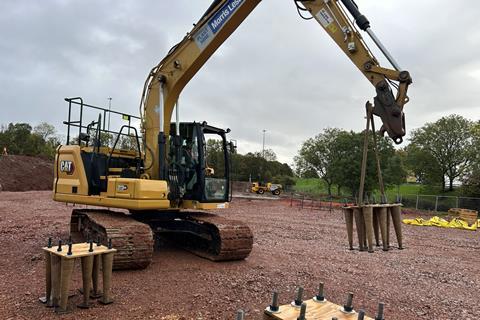
The shop gets relatively small bolt boxes containing four bolts, and these can be inserted into the concrete by hand. After the concrete is fully cured, vertical steel beams will be secured to the bolts, forming the shop’s skeleton.
The four canopy footings, meanwhile, get one large bolt box containing eight bolts apiece, with these lifted in by excavator, being too heavy to drop in manually.
Both small and large bolt boxes feature cardboard cones around each bolt, allowing for adjustment the day after the concrete is poured – when it is solid enough to hold them in their final position, but ‘green’ enough to allow for some movement.
The pour
Before all that happens, though, the concrete needs to arrive, but an issue with the plant’s computer system pushes things back by a couple of hours. Delays such as this, which can involve most site work pausing , mean forecourt firms undertaking a new build should allow a contingency of ”around 10 to 15% of the groundworks budget for unforeseen issues”, says Quarmby.
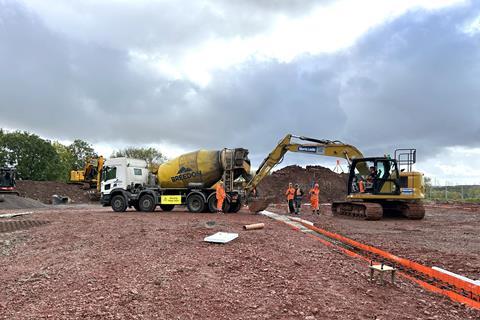
Before long the first mixer truck pulls onto site though. Rather than being deposited directly from the truck into the foundations, the concrete is instead poured into an excavator bucket, with the digger then driving the short distance to the trench and emptying its load.

This might seem a lengthy way of doing things, but it allows for more precise pouring and resolves access issues the mixer truck would have encountered for some of the foundations. Within just 20 minutes or so, the first length of the shop’s footing has been poured.
Workers follow the excavator as it progresses around the shop’s perimeter, tamping down each bucketload of concrete before using a laser level to ensure it sits at the correct height. Roughly two dozen bolt boxes are then inserted into the wet concrete that forms the foundations, their positions also carefully checked by laser. After half a dozen or so mixer trucks have been and gone, the shop’s footings are completed.
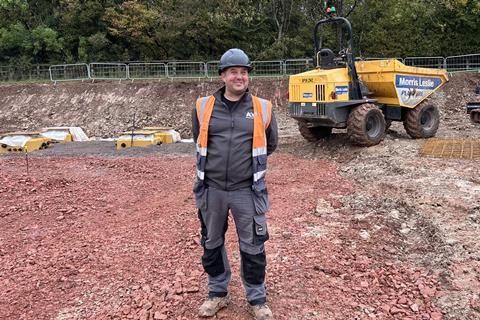
Next come the footings for the forecourt canopy’s legs and this is a less involved process, with the excavator depositing bucket after bucket of concrete into what is effectively a large hole in the ground – though sheets of steel mesh are inserted to add strength, and Paul Short tells us the depth of the footings is calculated based on local weather trends to ensure they’re deep enough for strong winds not to dislodge them.
Heavy-duty precision
This stage of groundworks is characterised by a mix of heavy-duty work and carefully measured engineering. Around 4,000 tonnes of earth have been excavated to get the project to this stage, for example, yet a pair of bolt boxes has been installed in precisely the right spot for the shop’s doorframe to be anchored to.
Similarly, while each excavator bucket can hold around 750kg of concrete, the driver manoeuvres his shovel to within centimetres of the mixer truck’s chute before depositing the concrete in precisely the right spot.
It’s an impressive spectacle, made all the more so given it took place in the driving rain, without a word of complaint from the team of seven men working on the site.