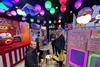
Vending machine arcade

Vending machine arcade: A self-service emporium

From touchless till touchscreens to vending machine arcades, Japan and South Korea give plenty insights into the changing world of retail technology. Forecourt operators Oliver Blake, David Charman, and Tom Dant share their highlights from a study tour to the two countries led by Spar earlier this month.

They were among 21 independent convenience store operators, and Spar regional distribution centre and head office staff, who visited around 20 stores in Tokyo and Seoul on a busy five-day itinerary which showed the innovation driving two of the world’s most dynamic convenience markets.

Stores included in the tour were 7-Eleven, FamilyMart, Lawson, Welcia, Aeon, Mega Don Quijote, Kinokuniya International, GS25, CU and Lotte Mart Zettaplex – with many outlets using technology to reduce staff interaction with the public, and with it costs.

David Charman, managing director of Parkfoot Garage in West Malling, Kent, says that he has come away wanting a version of the robot cleaners found at work in the stores before automatically returning to their charging stations. These were much larger than the versions you see cutting grass, or hoovering or mopping floors at homes throughout the UK, standing at several feet high and sometimes featuring advertising screens.

“Having a robot hoover around the store all day would make cleaning in the evening a much easier job, ” says Charman. ”Not unlike a Dusty Bin [from the 1970s Saturday night 3-2-1 gameshow], they would not be a trip hazard, and some of them had screens on them advertising the top offer of the day.”

Robot

Robotic cleaners were a hit with the visitors

The highlight for Oliver Blake, operations director at Oasis Services in Long Riston, Hull, was an iced drink concept, in which a blending machine was on hand for customers to mix cups of pre-packed ice displayed in a small chest freezer unit, with 400ml liquid sachets of drink on the shelving above.

This offered a relatively inexpensive way of giving customers a big choice of iced coffee and tea, with sachets including Black Martini Flavor [sic] Americano, Caramel Latte, Peach Iced Tea, as well as more child-friendly variants such as Kiwi Ade.

Frozen drinks

Iced tea Tokyo way

Self-service was a dominant feature, with a 7-Eleven visited in Tokyo operating unmanned tills which use holograms projected into midair to act as a contactless touchscreen, which can only be seen front on. Customers scan their goods, then finalise their purchase by poking in the air to interact with the holographic display.

“I believe it was introduced as a response to covid so that customers didn’t have to touch surfaces,” says Blake, “but it also has the advantage of taking up less space.”

Also, in retailers’ food to go offer, there were large beer and wine dispensing machines, and a station for customers to put hot water into tubs of ramen.

touchscreen2

Customers use the hologram self-checkouts by poking in the air 

Ramen

Hot water stations for customers to make ramen

The group even came across a vending machine arcade with seating in a shopping mall in Tokyo, dispensing ramen, freshly squeezed orange juice, and energy and health shots – which had prominent displays in many convenience stores.

The use of touchscreen food ordering, as seen at McDonald’s and Greggs, was prevalent. It is becoming a recognised tool in the UK too, with customers buying more from them than they would face to face with an employee taking their order, feeling unjudged on their food choices by ordering digitally.

Media screens, with instances of several found at till points, with a rolling sequence of adverts, kept queuing customers engaged.

And in-store theatre was created by making a feature of staff prepping food on site, with a view from the shopfloor to the kitchen area at several sites.

Tom Dant, managing director of Gill Marsh Forecourts, which operates three petrol filling stations in Lincolnshire, says that UK operators would generally struggle to replicate this with on-site kitchens, as they face double the staff costs as their Japanese and South Korean counterparts. 

Dant was particularly impressed with the presentation of the sites’ food to go range which was often made on-site and generally had “less carbs, and was more protein-based” than in the UK.

Southern fried chicken in numerous flavours and chicken with a sauce, with or without rice, was prevalent.

Chicken

Filling demand for a protein hit: Flavoured southern fried chicken

Dant says that South Korea had the edge in terms of technology, highlighting self-checkouts which, instead of having a member of staff on hand to help customers, used a 24-hour call centre with a TV screen with AI avatars as its interface.

Also, Dant liked the use of QR codes to give customers more information about beauty products. The QR codes, which were displayed on shelf edges, took customers through to a portal giving more details on the ingredients and benefits of using a particular product.

The National Guild Board of Spar holds international visits every two years, as part of the symbol group’s long-term investment in the future of convenience. The tours expose decision-makers to emerging trends, technologies and best practices that can be applied across its UK estate, says Spar UK retail and brand development director Ian Taylor.

“Organising study tours is all about exposing our independent retailers to what’s possible beyond the UK – helping spark new ideas, fresh thinking and ways to keep improving the customer experience in Spar stores,” says Taylor.

“From smart wine showcases and self-cooking stations to robotic cleaners and holographic self-checkouts, technology was at the core of many retail concepts.”

Media screens

The use of digital displays were popular in spots where customers queue

Screen

Stores made tactiful use of space, trading effectively across missions

Key takeaways Taylor says include:

  • The rise of retail media and interactive digital content at fixture level
  • The blurring of lines between drugstore and convenience formats
  • The popularity and placement of vending and self-service solutions
  • Tactical use of store space, with every inch trading effectively across missions
  • Clear and consistent in-store signposting and impactful POS execution

“Both markets demonstrated a relentless focus on the customer – with formats designed to deliver against clearly defined missions and shopper needs,” adds Taylor. “The learnings gathered are already influencing conversations on format development, own label evolution, and digital strategy here in the UK.”