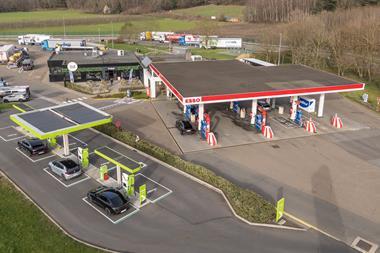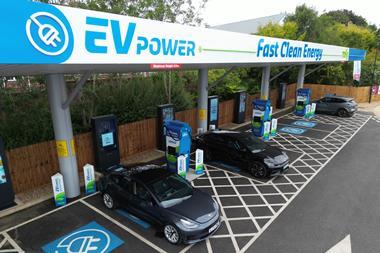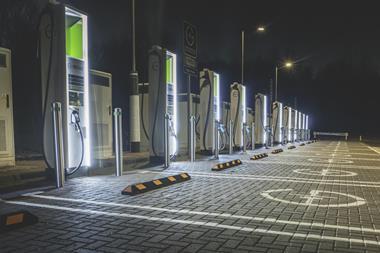




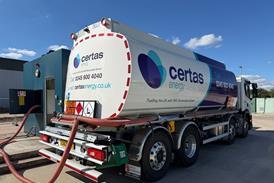









Looked at from a logical perspective, chargepoint firms and petrol-station operators are in the same game: providing juice to drivers.
Beyond that fundamental aspect, though, things are very different. Forecourts have emerged organically over the last century or so, while the ultra-rapid charging ‘hub’ is so new a concept that it was only recently that clear a definition – six or more chargers delivering at least 150kW – was settled on.
Even within the world of chargepoint firms, huge differences exist. Some, like Tesla’s Supercharger network, and Ionity, are backed by car companies, while others are supported by the UK’s public-private Charging Infrastructure Investment Fund, which was set up with £200m of taxpayer money, an amount since matched by private-equity backers.
Fastned does things slightly differently. The Dutch firm was co-founded in 2012 by Bart Lubbers, son of the former prime minister of the Netherlands. While a private company, Fastned is also a foundation which owns all shares, with certificates that stand in for these issued to investors.
There is clearly a philosophy at the heart of the firm, and this can be partly summed up by Lubbers himself, who in 2014 correctly identified that “driving is freedom”, adding that “EVs would never amount to much without this exhilarating sense of freedom”.
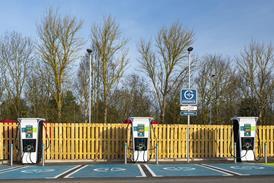
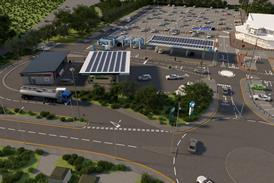
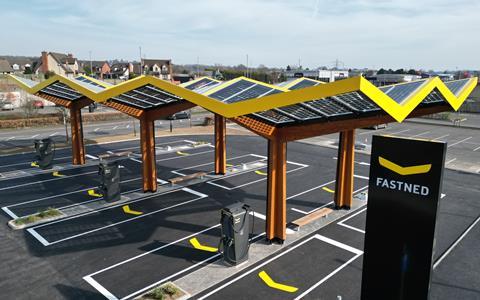
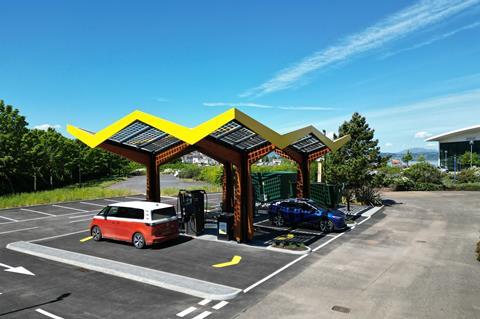
The solution as Lubbers sees it is to construct fast charging hubs “everywhere en route”, and over the last decade or so Fastned has opened around 350 European hubs, or “nature inspired stations”, as it calls them, with 35 in the UK. Each is characterised by a yellow-edged canopy topped with photovoltaic cells and termed “solar trees, with Fastned saying its hubs are designed not just to charge your car’s battery, “but your spirit as well”.
Things haven’t been entirely plain sailing, though. The firm made a loss of €26.6m (£23m) on revenue of €86m (£74.6m) in 2024, though in the chargepoint-provider world this is far from unusual, with Gridserve recently posting an £82.7m loss, and operators insisting the sector is all about being committed to playing the long game.
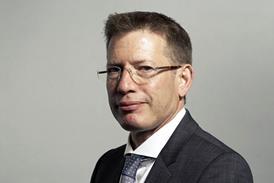
Forecourt Trader recently caught up with Fastned’s UK country manager, Tom Hurst, and grilled him on everything from what the firm has in store for the rest of the year, to why Alpitronic chargers are rapidly becoming the industry standard.
We begin by asking about a recent setback the firm had, when planning permission was refused for a new hub in the Oxfordshire village Eynsham.
“We’ve resubmitted a substantially revised scheme”, Hurst says, adding that “significant concessions”, including a lower canopy roof and increased screening have been made on the basis of concerns raised by local residents and authorities.
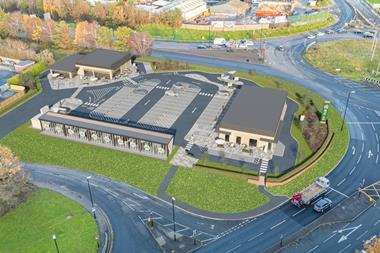
“No one in the industry will say that Fastned does things the easy way,” Hurst adds, explaining that the company has “always invested above and beyond” what is essential, and it is not interested in simply “sticking chargers in the ground”. Speaking of which, Fastned’s Hemel Hempstead hub is in “advanced stages of construction”, Hurst says, adding that that the company will be on the site “for decades”, something that factors into how they approach designing new developments.
“We’re a pure-play EV charging company,” he explains. ”All we sell is kiloWatt hours. We have to get that part right, then we can play all sorts of tunes with the land we’ve got.” This hints that diversification could be on the cards at some point in the future but, for now, Fastned remains all about plugs, power, and development opportunities.
Hurst is clear that what’s needed now is reassurance for drivers that public charging is both reliable and plentiful. “I need everyone in the industry to be changing people’s perspectives on availability,” he says.
On the topic of availability, earlier in the year Fastned opened new hubs in Banbridge and Antrim. Hurst says the firm looks set to be “rewarded for our early bet on the Northern Irish market”, with the distinctive design of its hubs likely to create a lasting impression on drivers in a region that has historically been seen as slow to add EV infrastructure. Interestingly, Fastned bought the land these two hubs sit on, unlike its mainland locations, where the company leases the land on 20-45-year contracts.
Also set to open soon is a new facility by Hatton Cross Underground station in West London, which is likely to cater for mini and Hackney cabs on airport runs to and from Heathrow – just as BP’s landmark EV-only Cromwell Road forecourt does.
Fastned is “expecting good news” on another site in London that’s still in the planning stages, Hurst teasing the project as “monumental”. Another ongoing development in Aberdeen is set to introduce “a new use of legacy infrastructure”, though Hurst is clear that this will be a very different project from rival chargepoint firm Be.EV’s Manchester hub, which was built on the site of a former filling station.
Speaking of Be.EV, Hurst echoes a point made by that firm’s chief executive, Asif Ghafoor, who said we’re very much entering the mass-market phase of EVs and everyday motorists, rather than evangelical early adopters, are becoming the norm. One way or another, Hurst says there are “no serious concerns about growth” where electric cars are concerned.
When pressed on profitability, particularly for forecourt operators considering EV chargers, Hurst speaks with admiration of MFG’s £400m investment in this area, though he recognises installing plugs can be “a big ask”, particularly for smaller firms who lack the purchasing power of larger operators, for whom negotiating more attractive prices for charging units and other costs is easier.
We ask Hurst why so many new projects feature hardware from Alpitronic, an Italian firm that began life designing power-supply units for aircraft to use when waiting at airports, but has since become a byword for ultra-rapid public chargers. The answer, Hurst says, is quite straightforward: “Their reliability and uptime are simply astounding.”
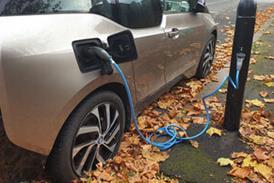
There has been much talk and a great deal money, given over to electric cars of late, with the £650m Electric Car Grant bringing the prospect of incentives back to retail buyers, and a further £63m earmarked for initiatives such as digging cable ‘gullies’ into pavements so those in terraced houses can recharge safely at home.
Yet the development that has got Hurst most excited is the recent announcement that EV charging hubs can now be advertised by the sides of main roads.
“I’ve been going on about this for years – since before covid,” he explains. “We’re in the mass-market stage of EV ownership, and it’s not reasonable to expect people to use an app to find a charger. People shouldn’t have to be prodding at screens when they’re driving at 70mph. Finding somewhere to recharge should be just as easy as finding a petrol station, and this is quite an easy problem to solve with road signs.”